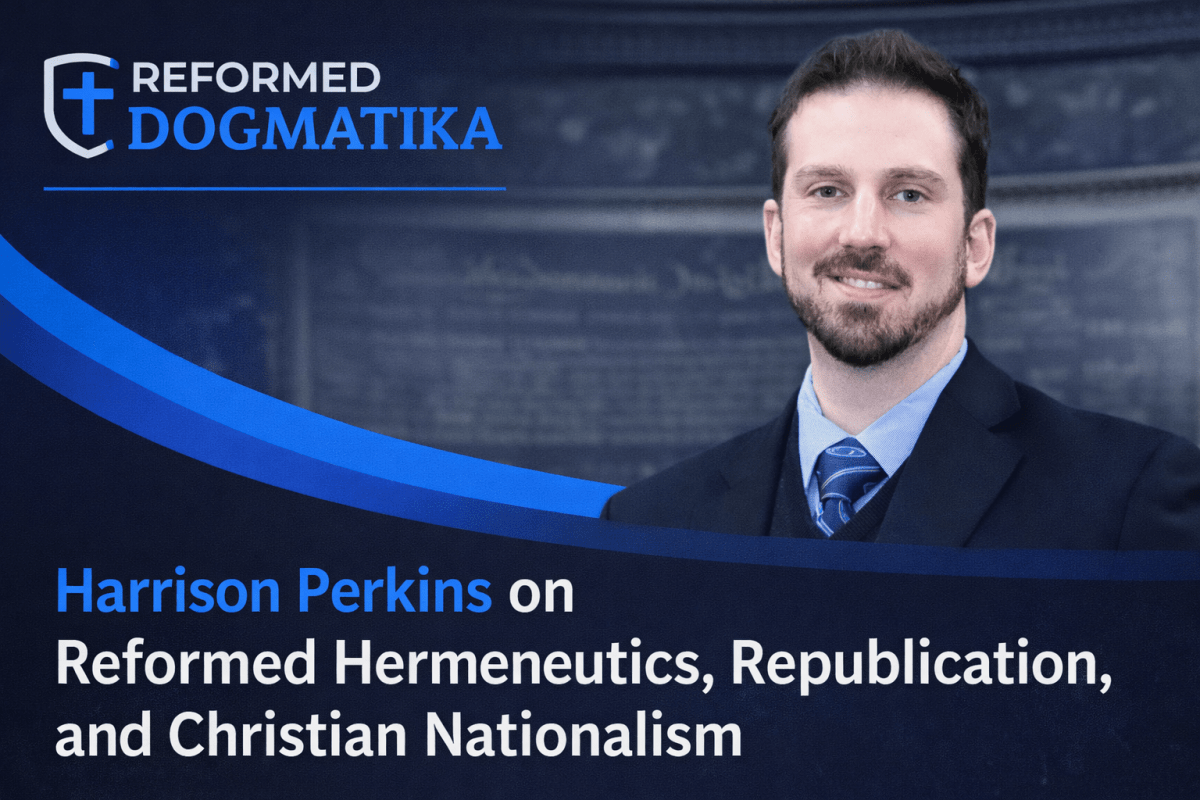
We recently had the privilege of sitting down with Harrison Perkins, pastor, theologian, and author, to discuss key issues in Reformed theology. As the pastor of Oakland Hills Community Church and a scholar engaged in theological education, Perkins brings a unique blend of pastoral care and academic rigor. Below are the highlights from our conversation, we hope you enjoy!
Meet Pastor Harrison Perkins
Harrison Perkins serves as the pastor of Oakland Hills Community Church (Orthodox Presbyterian Church) in the Detroit metro area. In addition to his pastoral role, he teaches at Westminster Theological Seminary and lectures in systematic theology at Edinburgh Seminary. Perkins also serves as a Senior Research Fellow for the Craig Center for the Study of the Westminster Standards.
A quick snapshot of his personal side: Perkins loves dark roast coffee, peanut butter, and Southern barbecue. But most importantly, he cherishes time with his wife, Sarah, and their son, Scott. His diverse roles and passions highlight his commitment to both God’s people and rigorous theology.
Harrison Perkins’s Favorite Theologian: James Ussher
Harrison Perkins cites James Ussher as the Reformed theologian who has most influenced him. Perkins describes Ussher’s writings as “solid, bread-and-butter Reformed theology.” Perkins did his PhD Thesis on James Ussher’s Doctrine of the Covenant of Works and it was published in the Oxford historical theology series.
“Though Ussher was appointed as a Westminster Assembly divine, he refused to attend because he was a Royalist. Ussher thought that the Assembly, as an Act of Parliament, shouldn’t be meeting because Parliament had no right to defy the King.”
Perkins explains, “The assembly divines nonetheless wanted his input even if he was unwilling to give it and used his works as…one important source for composing the Westminster standards. Both the Confession of Faith relying upon the Irish Articles, which he wrote, and then the Larger Catechism make a fair bit of use of his work called A Body of Divinity.” For readers interested in Ussher, Perkins recommends starting with A Body of Divinity.
Reformed Hermeneutics and the Law/Gospel Distinction
One of the defining marks of Reformed hermeneutics is the law/gospel distinction. Perkins explained its importance:
What is the Law/Gospel distinction?
“The law reveals God’s commands, while the gospel shows how we are made right with Him through Christ. The law convicts us of sin, driving us to Christ, while the gospel provides the solution to our inability to fulfill the law’s demands.”
Is it the only Reformed hermeneutic?
“It’s one hermeneutical consideration (an important one, yes), but not the whole template for understanding a text. You can’t simply say, ‘This passage is law, or this passage is gospel,’ and leave it at that. Both elements must work together to bring us to Christ.”
How does this distinction shape preaching?
“Even if a passage is primarily law, you still hope that, as it comes out in preaching, it leads us to the gospel. Likewise, when the gospel is front and center, we have to ask, ‘Why do I need the gospel?’, and that brings us back to the law.”
Common misunderstandings about law/gospel in Reformed theology
Perkins clarified, “Some argue that the law is bad, and the gospel is good, but that oversimplifies their roles. The law is God’s holy standard and is good; it drives us to see our need for grace. The gospel doesn’t abolish the law; it shows us how Christ fulfilled it on our behalf.”
The balance between the law and gospel in worship
“In worship, we must bring both to bear. The law humbles us, showing us our need for Christ, and the gospel lifts us up with the assurance of God’s unmerited grace. Together, they point us to Christ’s finished work.”
Understanding “Republication” in Covenant Theology
The concept of Republication has been a hotly debated topic in Presbyterian & Reformed churches. Perkins offered clarity on this issue:
What is Republication?
“The Mosaic covenant is an administration of the covenant of grace, but it also contains types and shadows that resemble the covenant of works. These types are pedagogical; they taught Israel about their need for a Savior and pointed to Christ’s fulfillment of the covenant of works.”
Why is it controversial?
“I think, partly because some important, well-loved theologians of more recent years have been opposed to it and that became the new baseline.” Perkins explained “Some argue that republication undermines grace, but I don’t see the conflict. We all agree that the Mosaic covenant has types and shadows pointing to Christ. The question is how those types function. I argue that some types under Moses point specifically to Christ fulfilling the covenant of works.”
Clarifying historical terms
“You won’t often find the word ‘republication’ in historical Reformed sources; they used terms like ‘repetition.’ But the underlying idea remains the same: the Mosaic covenant contains typological elements that teach about the covenant of works.”
The Mosaic covenant and Christ’s work
“The types and shadows in the Mosaic covenant show us two things: first, that the covenant of works must be fulfilled, and second, that we cannot fulfill it ourselves. The law in Moses ultimately directs us to Christ as the one who keeps the covenant perfectly on our behalf.”
What can we learn today?
“We need to see the grace in the Mosaic covenant. While it reminds us of the weight of the law, it also proclaims the gospel in shadows, pointing us to Christ’s fulfillment of every promise and requirement.”
For an more in-depth exploration of this topic, check out his book Reformed Covenant Theology on Amazon.
Two Kingdom Theology and Christian Nationalism
The relationship between the Church and culture is also a pressing topic today. Perkins unpacked the distinctions between Two Kingdom Theology and Christian Nationalism:
What is Two Kingdom Theology?
“God has appointed both the Church and the civil magistrate for distinct purposes. The Church’s mission is the proclamation of the gospel, while the magistrate is tasked with maintaining societal order and pursuing justice. They are both under God but operate according to different principles.”
How does it contrast with Christian Nationalism?
“Two kingdoms theology is really just about saying that God has appointed the Church and the civil magistrate for distinct purposes. God has appointed them both, but they don’t have the same mission, and they operate according to different principles.”
Perkins added, “Two kingdoms theology is really just about acknowledging the civil government’s job is not the gospel and the Church’s job is not to achieve the wider common goals that the civil government is supposed to achieve. And so, they’re spheres, both appointed by God, both responsible to God, but with distinct ends.”
“Two Kingdom Theology stresses that the government is not responsible for enforcing the gospel or defining true doctrine. The magistrate is accountable to God, but its mission is distinct from the Church’s.”
Concerns about cultural engagement
“When Christians conflate the missions of the Church and the state, it leads to confusion about the gospel. The Church should focus on proclaiming Christ, while individual Christians may engage society in ways that reflect biblical principles.”
Theonomy and its relevance
“Theonomy is a different matter. It argues for upholding the Mosaic civil law today, which goes beyond historical theocratic views. While Theonomy shares some DNA with Christian Nationalism, it’s ultimately a novel approach within the Reformed tradition.”
Further, “I think what we need are a distinction between theocracy and theonomy. Every theonomist is a theocrat, but not every theocrat is a theonomist. Theonomy says we uphold the whole Mosaic law. They are not just saying that the civil magistrate should uphold the whole moral law. They are saying also that the whole Mosaic civil law should still be in force.” Additionally, “have there been theocrats in the Reformed tradition? Of course. Yeah, which is different than saying there have been theonomists, because I think that theonomy is a greater novelty.”
“I think the big [issue] that’s on the table with the whole Christian Nationalist discussion is that we should have a magistrate, and some of them are saying a monarch. If I understand them correctly, that is responsible to uphold true religion.”
A call for gentleness in debates
“These discussions can get heated, but we’re called to be charitable. I remind people that we can disagree sharply without being unkind. The fruits of the Spirit (gentleness, kindness, and self-control) should characterize all our debates.”
A Preview of His New Book: “Righteous by Design”
Perkins’s new book, Righteous by Design: Covenant and Adam’s Original Integrity, offers a fresh defense of the law/gospel distinction:
What’s the book about?
“The book defends the Law/Gospel distinction through the lens of our doctrine of the image of God. Adam’s original righteousness shapes how we understand humanity before and after the fall, which then impacts how we frame salvation.”
What key insight can readers expect?
“The book challenges readers to see that Adam could merit eternal life under the covenant of works. Post-fall humanity, however, can only receive eternal life through God’s grace in Christ.”
Can we say that God condescending to man in the form of a covenant (Westminster Confession 7.1) was graceful?
“I want to challenge the premise and say that I think it’s a mistake to equate condescension with grace. In fact, I think [the Westminster Divines] chose that language precisely because this was a contested issue.” Perkins added, “I don’t think I skimped on that. I tried to go at it pretty tough.”
This book is a must read for anyone interested in how covenant theology intersects with the doctrine of man, soteriology, and the Law/Gospel distinction.
Final Reflections
Harrison Perkins offers a clear and thoughtful voice on some of the most debated issues in Reformed theology. From his insights on hermeneutics to his irenic and kind approach to controversial topics, Perkins demonstrates the value of theological clarity combined with pastoral sensitivity.
For more of his insights, keep an eye out for his new book, Righteous by Design and the forthcoming editions of James Ussher’s writings.
FURTHER STUDY
Dive deeper into how we read Scripture with Reformed Hermeneutics: Retrieving Faithful Interpretation in the Reformed Tradition.
Deepen Your Study
Join our community to receive Reformed reflections and resources delivered to your inbox.