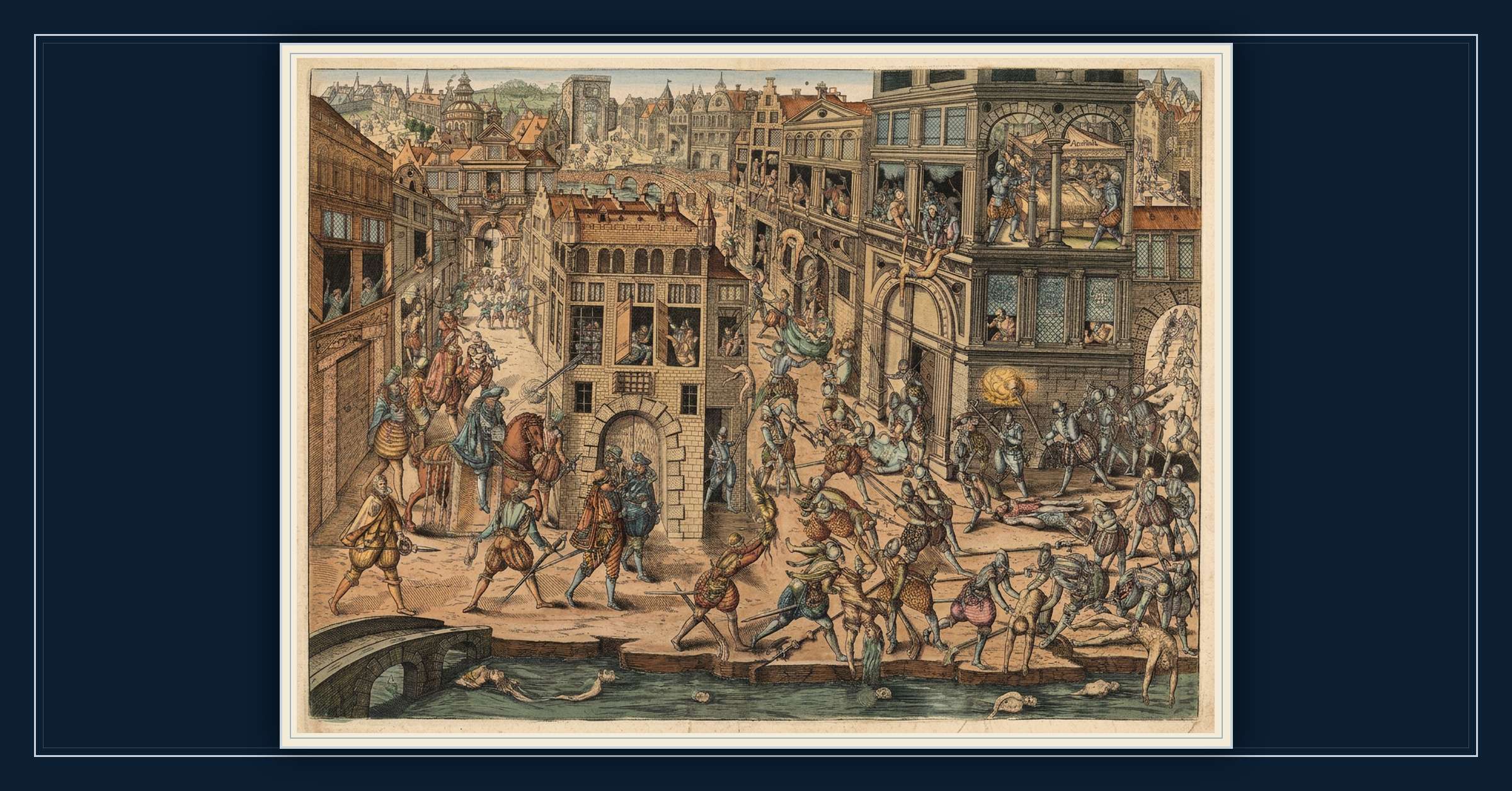
The Saint Bartholomew’s Day Massacre of 1572 is the bloodiest chapter in the story of the French Huguenots. They were Reformed Protestants whose faith and perseverance shaped the religious and political life of Europe.
What made it so tragic wasn’t the scale alone. It was the betrayal: state-sanctioned mass murder of fellow Christians during what was supposed to be a peace-making royal wedding.
What follows is a brief account of who the Huguenots were, what happened on August 24, 1572, and what their witness still says to Reformed Christians today.
Who Were the French Huguenots?
No one knows for sure how the French Protestants came to be called “Huguenots.” One leading theory is that in Tours, a spirit called “King Huguon” was thought to haunt a city gate where the Protestants held illegal nighttime services. A Catholic monk allegedly adopted the name as an epithet.1
The Huguenots were French Protestants shaped by the teachings of Martin Luther and John Calvin. By 1562, on the eve of the Wars of Religion, the Huguenots numbered roughly two million, about ten percent of France’s population. They were known as successful artisans and well-educated citizens.
From the beginning, they faced harsh opposition from the French monarchy and Catholic majority. Many of them sought refuge in fortified towns like La Rochelle where Reformed believers could worship in relative safety.
With tensions rising in the early days of the Reformation in France, John Calvin himself defended the early French Huguenots in his Preface to King Francis I of France in 1536, urging tolerance:
O King. May you be not at all moved by those vain accusations with which our adversaries are trying to inspire terror in you: we, from whom not one seditious word was ever heard; we, whose life when we lived under you was always acknowledged to be quiet and simple; we, who do not cease to pray for the full prosperity of yourself and your kingdom, although we are now fugitives from home!2
John Calvin Institutes of the Christian Religion, “Prefatory Address to King Francis I of France”
This plea reflects the Huguenots’ desire for peaceful coexistence within a Roman Catholic society they sought to reform, though it was largely ignored.
What Happened on Saint Bartholomew’s Day?
On the eve of the massacre, the Huguenots were confident the Reformed faith would ultimately prevail in France. Jean Morély boldly declared: “We have [Reformed] churches in nearly all the cities of the realm, and soon there will be scarcely a place where one has not been established.”3
Thousands of Huguenots had come to Paris for the royal wedding of Henry of Navarre and Marguerite de Valois on August 18, 1572. Henry was sympathetic to the Huguenot cause and was the future King of France. He would later become King Henry IV, famously converting to Catholicism to bring peace to a divided nation. Marguerite de Valois, a Catholic princess, was the sister of the reigning king, Charles IX.
Their marriage was intended to unite the warring Catholic and Huguenot factions. However, on August 22, just two days before the massacre, an assassination attempt was made on Admiral Gaspard de Coligny, a leading Huguenot representative. It sent shockwaves through the capital. Although Coligny survived the attack, the incident escalated tensions and stoked fears of a Huguenot retaliation.
Fearing a Huguenot uprising, and under pressure from his mother, King Charles IX gave the infamous order to eliminate all Huguenot leaders. What began as a targeted assassination plot quickly became a national bloodbath. Royal soldiers and Catholic mobs attacked Huguenot families indiscriminately. Admiral Coligny was among the first to be murdered, his body was mutilated and his headless body dragged through the streets.
In Orléans, Roman Catholics herded 1,000 Huguenots to the city wall and slaughtered them while mockingly chanting Psalm 43: “Vindicate me, O God.” In Lyon, thousands of Huguenot prisoners were butchered, and it was said that their blood turned the Rhone River red.4
“All Catholic France rejoiced in thought that the Huguenots…had been exterminated by the one blow.” 5
Scott M. Manetsch “The Saint Bartholomew’s Day Massacre,” Christian History
The Huguenot death toll is estimated between 5,000 and 25,000, with roughly 3,000 killed in Paris and the remainder across the provinces.6
Theodore Beza, a Huguenot and disciple of Calvin, wrote of the slain: “They were killed like sheep at the slaughterhouse.”7
As Catholics across France, Rome, and Spain rejoiced, the pope even issued a commemorative medallion to mark the “holy” event. While thousands of Huguenots were left shaken and demoralized, leaders like Theodore Beza clung to the promises of God, declaring: “The Church never triumphs except under the cross.”8
American author Esther Forbes summarized the long-term devastation for France as a nation:
“France had opened her own veins and spilt her best blood when she drained herself of her Huguenots, and everywhere, in every country that would receive them, this amazing strain acted as a yeast.”9
Esther Forbes Paul Revere and the World He Lived In
Persecution continued until 1598, when Henry IV issued the Edict of Nantes, granting limited religious freedom to the Huguenots. But that freedom came to an end in 1685, when Louis XIV revoked the Edict, again criminalizing the Reformed faith. The French crown even declared it illegal for Huguenots to leave the country, and many who were caught attempting to flee were executed.
How Did the Massacre Change the World?
While the massacre was a tragedy, God used it providentially to scatter the Huguenots across Europe and to America. Fleeing persecution, they carried the Reformed faith to places like the Netherlands, England, and colonial America, especially New York, South Carolina, and Florida.
Tertullian’s famous words again proved true: “The blood of the martyrs is the seed of the Church.”
Their commitment to the gospel of grace carried Reformed teaching to the New World, helped shape the case for religious liberty in emerging democratic societies, and strengthened the global Reformed witness.
What Can Reformed Christians Learn in 2026?
“Indeed, all who desire to live a godly life in Christ Jesus will be persecuted.” (2 Timothy 3:12)
To see how the Huguenot legacy speaks to us today, we’ve got to look at the theology that shaped them and at how that vision developed inside the Reformed tradition.
While Calvin distinguished between the spiritual kingdom (the church under Christ’s rule) and the civil kingdom (the magistrate’s rule), he affirmed that both ultimately fall under God’s sovereign authority.
“Still the distinction does not go so far as to justify us in supposing that the whole scheme of civil government is matter of pollution, with which Christian men have nothing to do.”10
John Calvin Institutes of the Christian Religion 4.20.2
As the Belgic Confession teaches, “We believe that this true church must be governed according to the spiritual order which our Lord has taught us in His Word” (Art. 30). The Huguenots lived and died under this conviction, even as the political powers betrayed them.
Reformed theologians like Abraham Kuyper and Herman Bavinck built on this foundation, emphasizing that Christ is Lord not only of the church but over every square inch of life, including the spheres of family, politics, education, the arts, and commerce.
Calvin’s framework clarifies the distinct roles of church and state, while Reformed theology reminds us there is no neutral ground in creation. We are to be salt and light, a leavening agent wherever God has placed us. All of life is lived coram Deo: before the face of God.
Herman Bavinck, writing centuries later, echoed this Huguenot instinct with his vision of a Christianity that transforms culture, not by the sword, but by the preaching of the gospel:
“The kingdom of heaven is leaven, and God sows that leaven until the whole lump is leavened.”11
Herman Bavinck “The Catholicity of Christianity and the Church”
The Huguenots lived this out.
Whether in business, education, family life, or public service, the Huguenots lived as those who belonged to Christ in all things. That conviction is no less urgent for us, in every sphere of life.
Legacy of the Huguenots
As we consider the legacy of the Huguenots, we can group what they leave us into three lessons that ought to shape Reformed conviction and Christian living today.
Lesson 1: Stand Firm in Faith
John Calvin wrote to the imprisoned Huguenot martyrs in Lyons:
Since it pleases Him to employ you to the death in maintaining His quarrel, He will strengthen your hands in the fight and will not suffer a single drop of your blood to be spent in vain. And though the fruit may not all at once appear, yet in time it shall spring up more abundantly than we can express.12
John Calvin Letter to the Five Prisoners of Lyon, May 15, 1553
Faithfulness to Christ sometimes requires suffering under unjust rulers. Scripture exhorts believers to live with humble integrity, even under hostile governance:
“Be subject for the Lord’s sake to every human institution…For this is the will of God, that by doing good you should put to silence the ignorance of foolish people.” (1 Peter 2:13-15)
Lesson 2: Live as Christ’s Ambassadors
Following the Huguenots’ example, Christians today are called to do their work well and to use their influence for the good of their neighbors and the advancement of the gospel.
“Whatever you do, work heartily, as for the Lord and not for men.” (Colossians 3:23)
The Huguenots shaped their host nations through skill, piety, and gospel proclamation. Likewise, we are to be “salt and light” (Matthew 5:13-16), contributing to our communities through honest labor, civic responsibility, and charitable witness.
“But seek the welfare of the city where I have sent you into exile, and pray to the Lord on its behalf, for in its welfare you will find your welfare.” (Jeremiah 29:7)
Lesson 3: Seek Peace and Truth
The St. Bartholomew’s Day Massacre warns us of the dangers of state-enforced religious uniformity. Sixteenth-century France bound throne and altar so tightly that the magistrate believed he was defending the faith by destroying dissenters. This history teaches us that a state-imposed Christianity does not guarantee a safe haven for the true church.
Our faith cannot be imposed by force. As Reformed believers confess, saving faith is a sovereign gift of God, granted through the preaching of the gospel and the regenerating work of the Holy Spirit (Canons of Dort, III/IV, Article 17).
Rather than resorting to coercion, we are called to trust that the gospel is the power of God for salvation (Romans 1:16) and to serve as a blessing to our communities, upholding a society marked by religious liberty for all. As Scripture urges:
“If possible, so far as it depends on you, live peaceably with all.” (Romans 12:18)
The massacre also revealed the destructive power of religious division. While the Huguenots sought peace and freedom of worship, Catholic extremists rejected coexistence.
Today, Reformed Christians must likewise pursue peace in our land while never compromising the truth of the gospel. We can engage in theological dialogue with others while holding fast to our biblical and confessional convictions.
The Huguenot Legacy and the Global Church
The Huguenot diaspora reminds us that we belong to a global body, the church of Jesus Christ across time and nations. As members of that body, we are called to support persecuted believers around the world through prayer, advocacy, and financial aid whenever possible.
Though the Saint Bartholomew’s Day Massacre may have appeared to signal divine abandonment, the survival of the Huguenots, and their eventual freedom under the Edict of Nantes, testifies to the providence of God.
As the Apostle Paul reminds us, “For those who love God all things work together for good, for those who are called according to his purpose.” (Romans 8:28)
The massacre was a dark and painful chapter, but not the end of the story. The faith and perseverance of the Huguenots call us to stand firm in our Reformed convictions today.
To remember the Huguenots is not merely to honor the past. It is to anchor our present convictions in the gospel they so dearly loved and were willing to die for. Their legacy calls us to live with courage, to serve faithfully, and to trust the sovereign God who carried them through the fire.
Footnotes
- Stephen M. Davis, The French Huguenots and Wars of Religion: Three Centuries of Resistance for Freedom of Conscience (Eugene, OR: Wipf and Stock, 2021), chap. 1; “Huguenots and the Wars of Religion: Did You Know?” Christian History, no. 71 (2001). ↩︎
- John Calvin, Institutes of the Christian Religion, trans. Henry Beveridge (Grand Rapids: Eerdmans, 1989), “Prefatory Address to King Francis I of France.” ↩︎
- Scott M. Manetsch, “The Saint Bartholomew’s Day Massacre,” Christian History, no. 71 (2001), section “The dangerous decade.” ↩︎
- Manetsch, “Saint Bartholomew’s Day Massacre,” section “The season of blood.” ↩︎
- Ibid. ↩︎
- Ibid. Manetsch estimates approximately 3,000 deaths in Paris and perhaps another 8,000 in provincial cities. ↩︎
- Théodore de Bèze to Thomas Van Til (Tillius), September 1572 (Letter 928), in Correspondance de Théodore de Bèze, Tome XIII (1572), ed. Alain Dufour and Béatrice Nicollier, Travaux d’Humanisme et Renaissance 229 (Geneva: Librairie Droz, 1988); Musée protestant, “St. Bartholomew’s Day (24th August 1572).” ↩︎
- Manetsch, “Saint Bartholomew’s Day Massacre,” section “The season of blood.” ↩︎
- Esther Forbes, Paul Revere and the World He Lived In (Boston: Houghton Mifflin, 1942); Huguenot Society of America, “Huguenot History.” ↩︎
- John Calvin, Institutes of the Christian Religion, trans. Henry Beveridge, 4.20.2. ↩︎
- Herman Bavinck, “The Catholicity of Christianity and the Church,” trans. John Bolt, Calvin Theological Journal 27, no. 2 (1992): 224–25, 248. ↩︎
- John Calvin to the Five Prisoners of Lyon, May 15, 1553, in Letters of John Calvin, ed. Jules Bonnet, vol. 2 (Philadelphia: Presbyterian Board of Publication, 1858), letter CCCX. ↩︎