Not long ago, an elder in a small Reformed congregation wondered whether his denomination had ever said anything official about a particular controversy making its way through the broader Reformed world. He wasn’t sure where to look. He wasn’t even sure his denomination had addressed it.
The answer, as it turned out, was yes—many years earlier. But the report was buried on an older website that no longer functioned well.
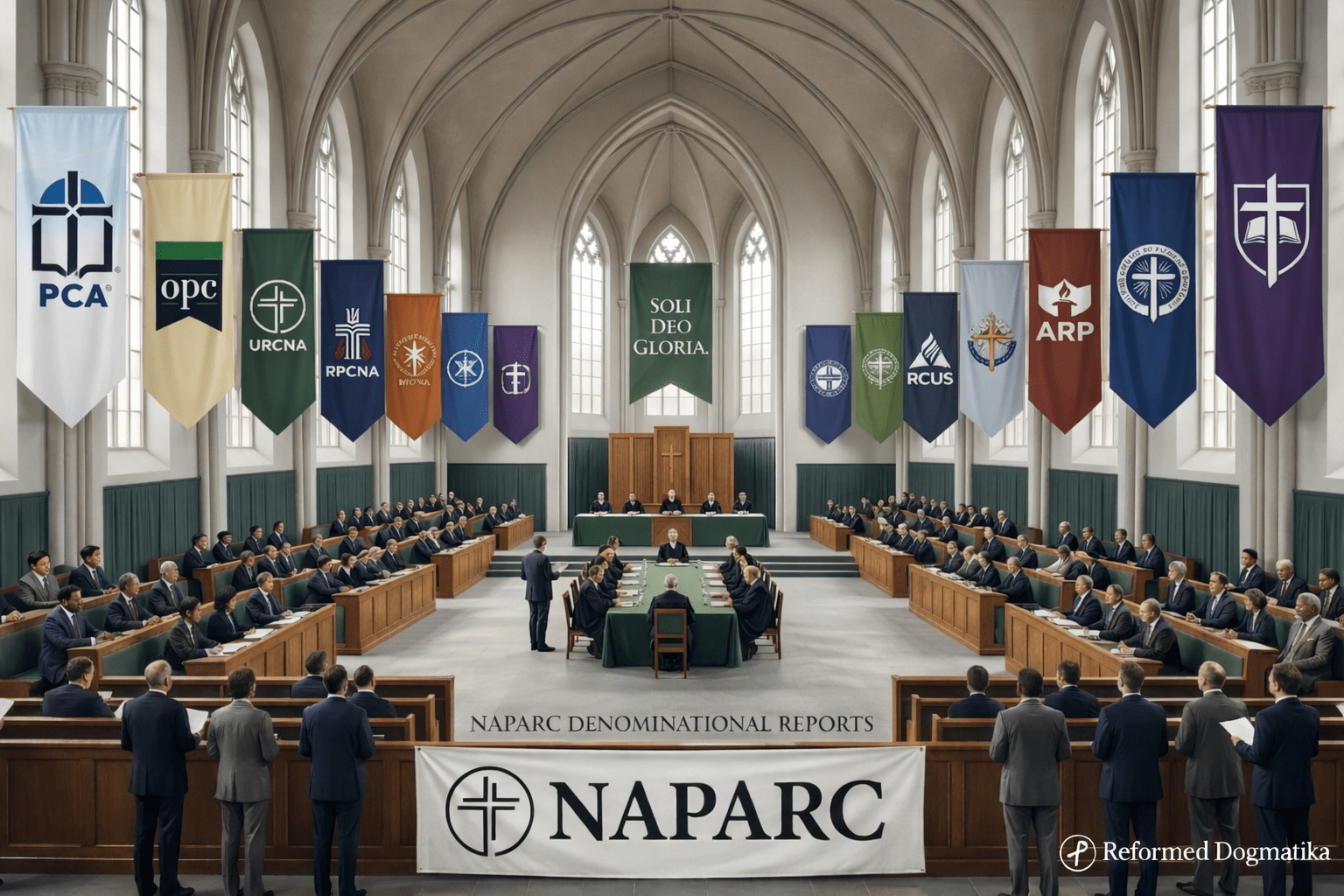
This article is an attempt to provide an up-to-date resource for all of the position papers of the North American Presbyterian and Reformed Council—NAPARC—home to thirteen confessional denominations that together represent the most concentrated body of Reformed theology being practiced and defended anywhere in the English-speaking world.
NAPARC churches have spent decades doing serious theological work: appointing study committees, wrestling with hard questions using the Scriptures and the Reformed confessions, and producing reports that most of their own members have never read. This post exists to change that.
What follows is the most comprehensive collection of NAPARC position papers and denominational study committee reports assembled in one place. Bookmark it, share it with your elders, and point your pastor to it.
What NAPARC Is, and Why It Matters
Founded in 1975, NAPARC is the only ecclesiastical council in North America that spans both the Three Forms of Unity and the Westminster Standards—thirteen confessional denominations bound not by evangelical sentiment but by the same Reformed confessions. Their constitutional basis says it plainly:
“Confessing Jesus Christ as the only Savior and Sovereign Lord over all of life, we affirm the basis of the fellowship of Presbyterian and Reformed Churches to be full commitment to the Bible in its entirety as the Word of God written, without error in all its parts, and to its teaching as set forth in the Heidelberg Catechism, the Belgic Confession, the Canons of Dort, the Westminster Confession of Faith, and the Westminster Larger and Shorter Catechisms.”
One word of caution before diving in: study committee reports aren’t constitutionally binding. Only the Confession of Faith, the Catechisms, and a church’s constitutional standards express binding doctrinal commitments. These reports represent the church’s careful reflection on a particular topic—and they deserve serious engagement on exactly those terms.
The Pillar Denominations
Presbyterian Church in America (PCA)
The PCA was founded in 1973 as a confessional continuation of historic Presbyterianism, and is now the largest NAPARC denomination, comprising roughly 69% of NAPARC’s total membership. It holds to the Westminster Standards and has produced one of the most extensive study committee report libraries of any Reformed denomination in North America.
→ PCA Study Committee Reports: Master Index (1973–2021) — PCA Historical Center
Selected major reports from this archive:
- Creation (2000) — Addresses the age of the earth, the days of Genesis, and related exegetical questions. Permits a range of views within the Westminster tradition.
- Federal Vision, New Perspective on Paul, and Auburn Avenue Theologies (2007) — The defining NAPARC-era evaluation of Federal Vision theology. Widely referenced across Reformed denominations.
- Women Serving in the Ministry of the Church (2017) — Reaffirms complementarianism while addressing practical questions of women’s ministry in PCA congregations.
- Human Sexuality (2021) — Addresses homosexuality, same-sex attraction, and transgenderism. Commended by the 48th General Assembly.
- Theonomy — One of the most thorough confessional critiques of theonomy from any Reformed body.
- Paedocommunion — Examines whether baptized covenant children should be admitted to the Lord’s Supper prior to a credible profession of faith.
- Baptism (four reports combined) — Includes reports on baptism and non-communing membership and the validity of certain baptisms.
- Fencing the Lord’s Table — A study on the proper administration of the Lord’s Supper.
- Evangelicals and Catholics Together: A Response (1994) — The PCA’s formal evaluation of the ECT document.
- Freemasonry (1987–1988) — Two reports examining the compatibility of Masonic lodge membership with Christian profession.
- Abortion (1978) — The PCA’s early and clear statement on the sanctity of unborn human life.
- Divorce and Remarriage (1992) — A thorough historical, scriptural, and pastoral treatment in three chapters.
- Child Protection (2014) — Overture 6 adopted by the 42nd General Assembly.
- Racial Reconciliation (2002)
- AIDS Task Force Report (1989)
- Domestic Violence and Sexual Assault (2022) — Ad Interim Committee report addressing domestic abuse, sexual assault, and best practices for sessions and presbyteries.
Orthodox Presbyterian Church (OPC)
Founded in 1936 by J. Gresham Machen to maintain Reformed orthodoxy against modernism, the OPC holds to the Westminster Standards and is widely regarded as the most rigorously confessional Presbyterian denomination in North America. Its General Assembly reports span nearly ninety years of careful theological reflection.
→ OPC General Assembly Reports — Official Index
→ OPC General Assembly Reports — Alphabetical Listing
The full list of available reports:
- Constitution (1936) — Drafted by Ned Stonehouse and J. Gresham Machen. Establishes the constitutional basis of the new denomination.
- Freemasonry (1942)
- Peniel (1961) — Report of the Committee to Examine the Current Doctrines and Practices of the Peniel Bible Conference.
- Song in Worship (1946–47) — An early and significant treatment of psalmody and hymnody in Reformed worship.
- The Free Offer of the Gospel (1948) — One of the most cited documents in twentieth-century Reformed theology, addressing the sincere and well-meant offer of the gospel to all sinners.
- Refusing to Baptize Children (1966)
- Abortion (1971)
- Sabbath (1973)
- Race (1974)
- Gifts of the Holy Spirit (1978) — The OPC’s careful evaluation of the charismatic movement and the question of sign gift continuation.
- Diaconal Ministry (1984)
- Paedocommunion (1987) — Contains both the committee report and minority reports. The 1988 Assembly ultimately opposed paedocommunion.
- Women in Office (1988) — The OPC’s definitive treatment of the question of women in ordained church office.
- Unordained Persons in Worship (1991)
- Women in Combat (2001)
- Creation (2004) — Addresses the Framework Hypothesis, the Day-Age Theory, and the historic 24-hour day position.
- Justification (2006) — The OPC’s response to Federal Vision theology and the New Perspective on Paul.
- Illegal Aliens (2007)
- Republication of the Covenant of Works (2016) — The most detailed and balanced treatment of the republication question produced by any NAPARC body. Essential reading.
- Equipping Officers to Protect the Flock (2024)
- Criminal History and Officer Qualifications (2025)
United Reformed Churches in North America (URCNA)
The URC was formed in 1995 by congregations departing the Christian Reformed Church over its decision to open ordained office to women. The URCNA holds to the Three Forms of Unity and maintains one of the most rigorous confessional cultures in contemporary North American Reformed Christianity.
→ URCNA Index of Synodical Decisions
→ URCNA Synodical Archive (Full)
Key reports and documents:
- Federal Vision and Justification (2010) — Adopted by Synod London 2010. The URCNA’s definitive confessional response to Federal Vision theology, with contributions from Cornelis Venema and Michael Horton.
- URCNA–OPC Study Committee Report — A joint study comparing the confessional standards, church orders, and forms of government of both denominations, produced as part of ongoing dialogue toward ecclesiastical union.
- Synod 2001 Decision on Creation — The URCNA’s foundational statement on creation and the days of Genesis.
- Marriage Affirmations — Synodical affirmations on the nature of marriage.
- Report on the Level of Doctrinal Commitment Necessary for Membership — A pastoral document on subscription and confessional integrity within URCNA congregations.
- Pastoral Advice Documents — Collected pastoral advice issued by synod on various matters of church life and practice.
- Acts of Synod Escondido 2024 — Includes reports on Digital Media and Worship and Human Sexuality.
- Acts of Synod Niagara 2022
- Office of Deacon in the Churches (1997) — The URCNA’s foundational study on the diaconal office, adopted at Synod St. Catharines.
- Pastoral Advice on Justification (2007) — Synodical pastoral advice issued following the Federal Vision controversy.
- Pastoral Advice on Doctrinal Commitment (2012) — Guidance on the level of confessional commitment expected of URCNA members.
- Pastoral Advice on Membership Departures (2016) — Synodical guidance on how congregations should handle members who depart. (See Church Order Appendix 8.)
- Pastoral Advice on Human Sexuality (2024) — The URCNA’s most recent synodical guidance on human sexuality.
- Pastoral Advice on Digital Media and Worship (2024) — Synodical guidance on digital media use in the context of corporate worship.
The Broader NAPARC Family
Associate Reformed Presbyterian Church (ARP)
Rooted in the Scottish Seceder tradition, the ARP traces its North American history to 1782 and holds to the Westminster Standards. Its General Synod has produced substantial study papers through its Committee on Theological and Social Concerns.
→ ARP Position Statements and What We Believe
Notable statements include the 2009 Biblical Inerrancy Position Statement, the Human Sexuality Position Statement (2019), the Women in the Life of the Church position paper (under amendment following the 2025 Synod), the 2016 Race Relations Report, and a formal position statement opposing the conscription of women into military combat. All of these are accessible at the What We Believe page linked above.
Reformed Presbyterian Church of North America (RPCNA)
Known historically as the Covenanters, the RPCNA was among NAPARC’s founding members in 1975. It maintains a distinctive testimony for Christ’s crown rights over the nations and practices exclusive psalmody and a cappella worship. Its Constitution includes the RPCNA Testimony, a supplementary confessional document unique to the denomination.
→ RPCNA Convictions and Constitutional Documents
→ RPCNA Digest and Index of Synodical Decisions (Complete)
Reformed Church in the United States (RCUS)
Founded in 1725 by German Reformed immigrants in Pennsylvania, the RCUS holds to the Three Forms of Unity and maintains a strong commitment to six-day creationism, confessional integrity, and historic Reformed worship. Its 1999 Days of Creation report is one of the most direct defenses of six literal 24-hour creation days from any NAPARC denomination.
→ RCUS Documents and Downloads
Selected completed position papers (directly linkable):
- Days of Creation (1999) — One of the most direct defenses of six literal 24-hour creation days from any NAPARC denomination.
- Justification and Norman Shepherd (2004) — The RCUS’s study of Norman Shepherd’s doctrine of justification and its deviation from the Reformed confessions.
- New Perspectives on Paul (2005) — The RCUS’s evaluation of the New Perspective on Paul, particularly the work of N.T. Wright.
- Federal Vision (2006) — The RCUS’s definitive rejection of Federal Vision theology on confessional grounds. One of the most direct denominational condemnations available.
- Cremation (2019) — A thorough historical, biblical, theological, and pastoral examination of cremation as an alternative to Christian burial.
For a full listing of all thirteen NAPARC member churches, visit www.naparc.org.
A Cross-Denominational Reading Guide
NAPARC’s member churches have repeatedly wrestled with the same questions in the same era. Reading across denominational lines on a single topic is some of the most productive theological work a pastor or elder can do.
On Justification and Federal Vision: Three independent confessional bodies—the OPC in 2006, the PCA in 2007, and the URCNA in 2010—each examined Federal Vision theology and arrived at the same conclusion. Read together, these reports represent the most unified and thorough Reformed response to Federal Vision available anywhere.
On Creation: This is where the denominations diverge, and that’s worth knowing. The PCA’s 2000 and the OPC’s 2004 reports both permit a range of interpretive positions within the Westminster tradition. The RCUS’s 1999 Days of Creation and the URCNA’s 2001 decision hold the more rigorously six-day position.
On Women in Office: The OPC’s 1988 report is the most exegetically precise treatment of the question in the NAPARC family. The PCA’s 2017 report covers similar ground. The ARP’s Women in the Life of the Church rounds out the Westminster tradition’s engagement with the topic.
On Republication of the Covenant of Works: The OPC’s 2016 report is the most thorough treatment of this question produced by any NAPARC body. If republication is on your session’s or consistory’s agenda, start here.
On the Free Offer of the Gospel: The OPC’s 1948 Free Offer report stands alone. It’s the most important single document on this subject produced in the twentieth century by any Presbyterian or Reformed body. If you haven’t read it, that’s where to start.
NAPARC Itself
NAPARC maintains its own website with constitutional documents and press releases from annual meetings.
To our knowledge, this is the most complete publicly accessible collection of NAPARC position papers available anywhere online. We’ll update this post periodically as new reports are published and links are verified. If you notice a broken link or know of a significant denominational report that isn’t represented here, we’d love to hear from you through the contact page. Reformed Dogmatika is committed to making the confessional riches of the NAPARC family accessible to the whole church.
Soli Deo Gloria.