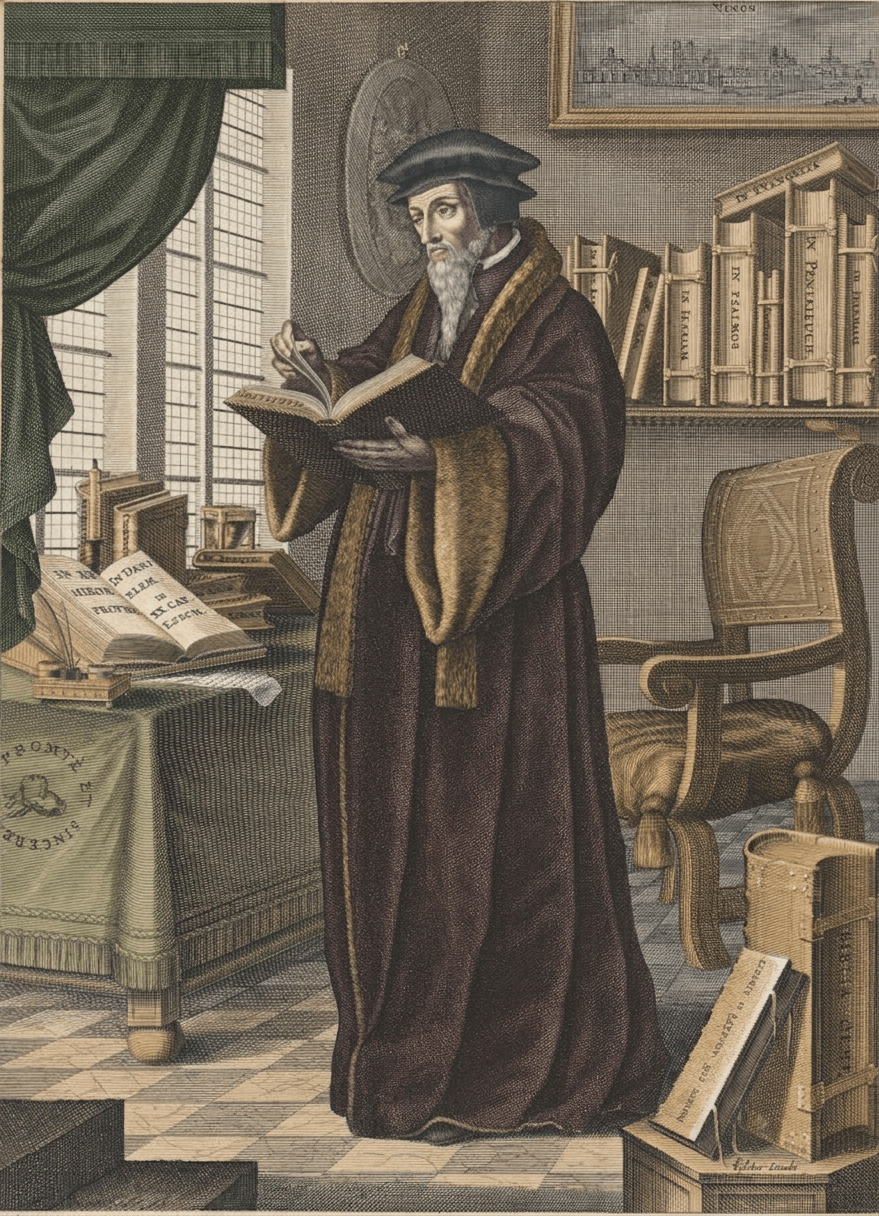
Of everything Calvin wrote, this is the short book I love to return to.
It isn’t an independent work, exactly. It’s five chapters lifted out of the third book of the Institutes (3.6 through 3.10), where Calvin turns from doctrine to the shape of an ordinary Christian day: self-denial, bearing the cross, the hope of the life to come, and how to use the things of this world without being ruled by them. Publishers have printed those chapters on their own for many years and called them the Golden Booklet, because it’s the heart and soul of Calvin’s theology.
The Heart of the Book
Here’s Calvin’s main thesis:
We are not our own; therefore, neither is our own reason or will to rule our acts and counsels. We are not our own; therefore, let us not make it our end to seek what may be agreeable to our carnal nature. We are not our own; therefore, as far as possible, let us forget ourselves and the things that are ours. On the other hand, we are God’s; let us, therefore, live and die to him.1
John Calvin
Institutes of the Christian Religion 3.7.1
In four sentences, Calvin hands us the ground of a faith-fueled obedience, and he does it without a single scolding word. He is only pressing home what Paul told the Corinthians (1 Corinthians 6:19-20): we are not our own; we belong to God, and everything else in the Christian life follows from that.
Where to Start
If you’ve wanted to read Calvin but find the Institutes too daunting, start here instead. This is Calvin the pastor, writing for people who have to get up in the morning and live. And if your preferred reading runs to books on practical Christian living, keep this one near at hand and open frequently.
The whole edition is free to read on Reformed Dogmatika: Calvin’s Golden Booklet of the True Christian Life.
Best Quotes from Calvin’s Golden Booklet
A few of the lines readers keep coming back to, all from the free reading edition. Tap “Tweet this” under any quote to share it.
We are not our own; therefore, neither is our own reason or will to rule our acts and counsels.
We are God’s; let us, therefore, live and die to him.
Doctrine is not an affair of the tongue, but of the life.
Those who are much occupied with the care of the body, usually give little care to the soul.
For he who has learned to look to God in everything he does, is at the same time diverted from all vain thoughts.
If to be freed from the body is to gain full possession of freedom, what is the body but a prison?
We are not our own; therefore, as far as possible, let us forget ourselves and the things that are ours.
In bearing them patiently we are not submitting to necessity but resting satisfied with our own good.
We are not to look to what men in themselves deserve, but to attend to the image of God, which exists in all, and to which we owe all honour and love.
The endowments which God has bestowed upon us are not our own, but His free gifts.
Footnotes
- John Calvin, Institutes of the Christian Religion 3.7.1 (Beveridge). ↩︎
FURTHER STUDY
New to Calvin’s big book? Five Myths That Keep You From Reading the Institutes clears away the fears that keep readers on the sidelines.
Deepen Your Study
Join our community to receive Reformed reflections and resources delivered to your inbox.