


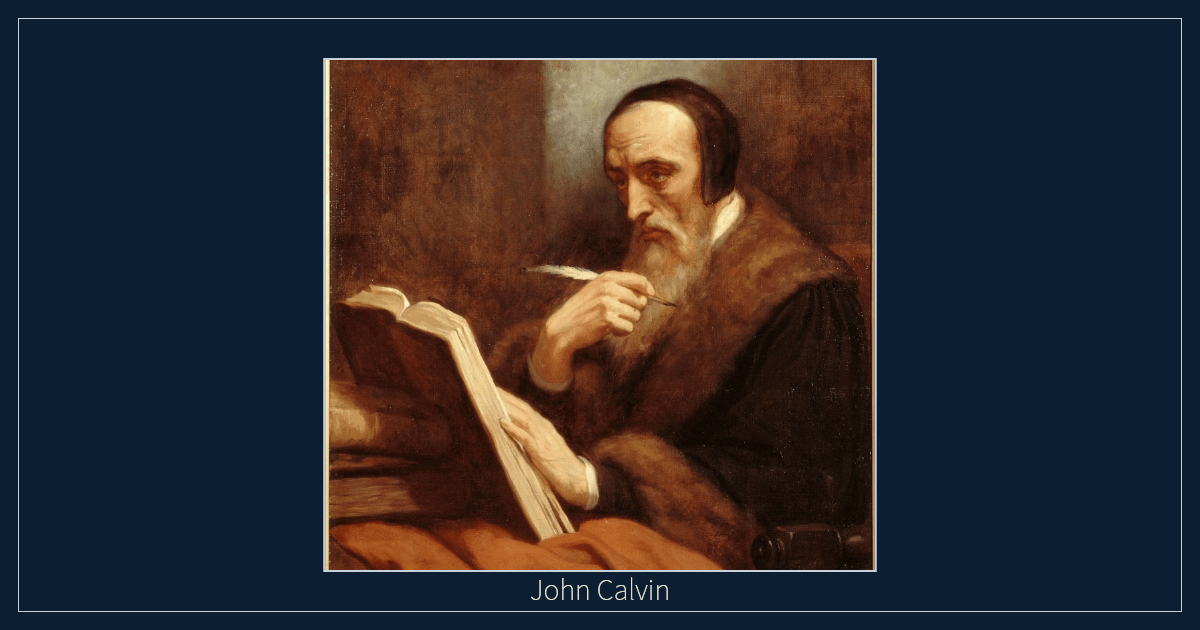
There’s a word that makes many Christians sweat before they’ve even heard the case: predestination. Say it in the wrong Bible study and you will watch faces tighten and feel temperatures rise. It initially sounds like fate, like a God who moves people around a board game, smiling at predetermined outcomes. But that isn’t the God of the Bible. It’s a caricature.
Dinesh D’Souza recently repeated several forms of that caricature. Here is my claim-by-claim response to his case against Calvinism.
The doctrine of predestination is a pastoral truth because it gives Christian assurance its deepest foundation. We do not search God’s hidden decree for our names. We look to Christ and believe his promise.
Everyone the Father gives the Son will come, and Christ will lose none of them (John 6:37-40). Paul draws the same line from predestination through calling and justification to glory (Rom. 8:29-30).
I’m not writing this from a safe distance. I was raised as a Lutheran, and when I eventually worked up the nerve to teach Romans 9 in a Sunday school class at my Lutheran church, it didn’t go over well. In the end, this doctrine became the final nail in the coffin. Leaving was painful. But the text was unmistakable, and you can’t unsee what you have seen.
What the Doctrine Actually Teaches
Calvin opens his treatment of predestination in the Institutes with a pastoral argument, not a philosophical one:
“We shall never be clearly persuaded, as we ought to be, that our salvation flows from the wellspring of God’s free mercy until we come to know his eternal election, which illumines God’s grace by this contrast: that he does not indiscriminately adopt all into the hope of salvation but gives to some what he denies to others.”
—John Calvin, Institutes of the Christian Religion 3.21.1 (Battles)
Pause for a moment and savor Calvin’s thought. If salvation flows from the wellspring of free mercy (and it does), it flows from a source we never dug and could never reach. We had no claim on it, and no good work earned it for us. So-called foreseen faith cannot be the ground of election, because even the faith by which we receive Christ is God’s gift (Eph. 2:8-9).
Election strips human boasting of every last foothold, that’s why so many resist it. But the humbling truth is that our salvation is completely by grace alone, independent from a single good work we perform.
Loraine Boettner, whose book The Reformed Doctrine of Predestination remains a classic nearly a century after its 1932 publication, pressed this point: this doctrine is not something John Calvin invented. It’s the recovery of the apostolic theology of grace that the medieval church had largely obscured.1
Calvin himself agreed. “No doctrine is more useful,” he wrote, “provided it be handled in the proper and cautious manner of which Paul gives us an example, when he presents it as an illustration of the infinite goodness of God, and employs it as an excitement to gratitude.”2
That matters, because this is not a sixteenth-century novelty or a harsh theological option for people who enjoy arguments. The Reformed doctrine of predestination is the historic teaching of Paul, Augustine, the Reformers, and the great confessions.
The Westminster Confession of Faith (3.1) defines the scope: God “from all eternity did by the most wise and holy counsel of His own will, freely and unchangeably ordain whatsoever comes to pass.” It immediately adds that God is not the author of sin and does not force the person’s will. The choices and events through which his decree comes to pass remain real.
That is the difference between God’s decree and fate. God does not move people like pieces on a board. They act from their own desires and remain responsible for what they do.
Sproul brings the doctrine home by showing what God’s decree means for every one of us:

Paul’s concern reaches beyond the family line that led to Christ. His question is why God’s word has not failed when so many Israelites remain in unbelief (Rom. 9:6). He distinguishes natural descent from the children of promise, then moves to Jacob and Esau, God’s mercy and hardening, and vessels prepared for glory. By verse 24, he identifies the vessels of mercy as those God has called from both Jews and Gentiles.
The Canons of Dort (1.7), the Reformed church’s official response to the Arminian objections of 1618, defines election as God’s “unchangeable purpose” by which he “chose from the whole human race, which had fallen through its own fault from its original integrity into sin and destruction, a certain number of persons to redemption in Christ.” Not because of anything foreseen in them, but according to the good pleasure of his will.
The Triune God Saves
Predestination belongs to the saving work of the Triune God (Eph. 1:3-5). The Father chooses a people and gives them to the Son (John 6:37-39). The Son lays down his life for them (John 10:14-15), and the Spirit brings them to faith (2 Thess. 2:13-14). Salvation begins with God and reaches its goal because God carries it through (Rom. 8:29-30).
Our study of the doctrines of grace gives a fuller account of this saving work.
Why We Need It: The Human Condition
The doctrine of predestination doesn’t begin with God’s will as a whimsical choice. It begins with God’s wise and unchanging counsel, applied to fallen sinners.
Scripture describes the fallen human condition as “dead in trespasses and sins” (Eph. 2:1), with minds “hostile to God” that “cannot submit to God’s law” (Rom. 8:7). Jesus himself draws the same conclusion: “No one can come to me unless the Father who sent me draws him” (John 6:44). What Scripture describes is total inability.
R. C. Sproul describes spiritual death in Chosen by God: “The person who is spiritually dead cannot, in his own flesh, gain the profit of Christ. He is described as one who has no fear of God before his eyes (Rom. 3:18).”3
A man at the bottom of a well can choose any direction he wants. He can argue about the weather, debate about politics, or decide to look up or down. But he cannot climb out. Not without a rope from above.
Total inability is not about external compulsion; it’s about the internal incapacity that leaves sinners unable to do the one thing that would save them: genuinely desire and turn to Christ.
Martin Luther describes the bondage of the will: “Free will, after the fall, exists in name only, and as long as it does what it is able to do, it commits a mortal sin.”4
Bavinck tells us what total inability does not mean: “Although we are dead in sins and trespasses, and have of ourselves no capacity in this world to do anything supernaturally good, God does not treat us like lifeless creatures, pieces of wood and brick, or like mindless beasts.”5
The will remains bound without being erased, so our responsibility stands even as God must take the saving initiative.
The Ground of Election: Grace, Not Merit
This is where predestination becomes a humbling truth. If God must act first, and if that action is not based on anything he foresees in us, then election is entirely a matter of divine grace. Salvation is monergistic: God alone gives life.
Boettner writes: “Foreseen faith and good works, then, are never to be looked upon as the cause of the Divine election. They are rather its fruits and proof.”6
That principle, that election rests on God’s purpose rather than anything foreseen in us, echoes Paul’s language in Ephesians 1. He sets the clock back as far as it will go: God “chose us in him before the foundation of the world” (Eph. 1:4).
Then in verse 5 he presses the point further: God “predestined us for adoption to himself as sons through Jesus Christ, according to the purpose of his will.” Not according to our foreseen faith or virtue, but only according to his will. The decree is grounded in God’s divine freedom, not human merit.
Paul shifts from “we” to “you also” in verses 12 and 13 as he turns from Jewish believers to the Gentiles who heard the gospel. The change does not place those Gentiles outside God’s choice. They receive the same Spirit and inheritance, and Paul later calls them fellow heirs and members of the same body (Eph. 1:13-14; 3:6).
Sproul gives the conclusion: “God sovereignly brings to pass the salvation of his elect and only of his elect.”7
That is not a cold plan. For anyone who believes, it’s a description of both the how and why of their salvation. Lazarus did not reach for life because a dead man could not; Christ called him by name, and only then did breath return. Every Christian’s spiritual resurrection follows that same pattern. God’s monergistic grace gave us spiritual life, and faith followed (John 15:16).
The Hard Question: What About the Others?
We can’t dodge the follow-up question. If God elects some, what happens to everyone else? Sproul answers:
“God gives mercy to the elect by working faith in their hearts. He gives justice to the reprobate by leaving them in their own sins. There is no symmetry here. One group receives mercy. The other group receives justice. No one is a victim of injustice. None can complain that there is unrighteousness in God.”8
R. C. Sproul Chosen by God
The key word is justice. God does not condemn the reprobate for no reason. He doesn’t drag them into sin against their will and then punish them for it. He passes over them, leaving them in the condition they are already in: sinners who have rejected him. Mercy is freely given to some and justice is rendered to the rest. No one receives injustice.
The Westminster Confession of Faith draws this line carefully. God passes by the rest of mankind and “ordains them to dishonor and wrath for their sin, to the praise of his glorious justice” (WCF 3.7). God’s decree doesn’t create their sin; it gives to sin the punishment it deserves.
No one is dragged into hell kicking and screaming for Christ; the reprobate go willingly. On the last day they won’t say to Christ, “I wanted to come to you but you stopped me.” They will acknowledge, “I never wanted you in the first place.” That is the sad but honest end of every human life lived in willful unbelief.
This is a very hard truth, to be held soberly and without arrogance. But the charge that predestination makes God a cruel tyrant rests on the assumption that fallen sinners are owed mercy because their sin really isn’t that serious. That is precisely what Scripture denies. “None is righteous, no, not one…no one does good, not even one” (Rom. 3:10, 12).
Predestination Ends in Praise
Paul carries predestination to its fitting end: believers on their knees in humility and thanksgiving.
Our salvation was planned before we drew a breath, accomplished by the Son, applied by the Spirit, and protected by a decree that cannot be overturned. Paul gives us the fitting response in Romans 11: “For from him and through him and to him are all things. To him be glory forever. Amen.”
Soli Deo Gloria.
Footnotes
- Loraine Boettner, The Reformed Doctrine of Predestination (Presbyterian and Reformed Publishing, 1932), 2. ↩︎
- John Calvin, Institutes of the Christian Religion 3.21.1 (Beveridge). ↩︎
- R. C. Sproul, Chosen by God (Tyndale House, 1986), 112. ↩︎
- Martin Luther, “Heidelberg Disputation” (1518), thesis 13, in Luther’s Works, vol. 31, ed. Harold J. Grimm (Fortress, 1957), 40. ↩︎
- Herman Bavinck, Reformed Ethics, vol. 1: Created, Fallen, and Converted Humanity, ed. John Bolt (Baker Academic, 2019), 234. ↩︎
- Boettner, The Reformed Doctrine of Predestination, 98. ↩︎
- Sproul, Chosen by God, 138. ↩︎
- Sproul, Chosen by God, 148. ↩︎



You must be logged in to post a comment.