


Recently, while scrolling through my X feed, I came across a post that seemed to be drawing some heat. It concerned Craig A. Carter’s announcement that he was no longer a Baptist and had become a Presbyterian. He explained his decision in “My Journey to Presbyterianism.”

Having made a similar change myself, I was curious about what had led him to that decision. As I read his account, I recognized several questions I had once worked through.
Carter looks back to 2016, when he thought he had two disagreements with the Westminster Confession of Faith. He believed baptism should follow a profession of faith, and he believed each congregation should govern itself. He had held to the doctrines of grace since his youth, so those differences seemed small enough to live with. Ten years later, after a year at Christ Church Toronto, he was received into the Presbyterian Church in America as an honorably retired teaching elder.1
I understand why those differences can seem small at first. When I began corresponding with R. Scott Clark, a professor at Westminster Seminary California, I was attending a Baptist church and already held to the five points of Calvinism. Infant baptism was still a question for me.
Dr. Clark took my questions seriously. He answered my emails and direct messages and gave me things to read. Over time, I became convinced of the Reformed case for baptizing the children of believers.2
I’m also grateful to Michael G. Brown for Sacred Bond: Covenant Theology Explored, which he wrote with Zach Keele. That book helped me distinguish God’s everlasting covenant with Abraham from the later, temporary Mosaic administration. God calls his covenant with Abraham an “everlasting covenant” (Genesis 17:7), and Paul explains that the law given through Moses did not cancel God’s earlier promise (Galatians 3:17). Under Moses, God continued to administer the same covenant of grace. That distinction helped me understand why the end of the Mosaic administration did not mean the end of God’s promise to believers and their children.
Why a question about baptism leads back to Abraham
One part of Carter’s article really caught my eye. He’d thought his differences with the Westminster Confession were about baptism and church government. He came to see that those differences went back to Chapter 7 and how he understood the covenant of grace. In this covenant, God freely offers sinners life and salvation through Jesus Christ (Westminster Confession 7.3).
To see why Reformed churches baptize believers’ children, start with God’s promise to Abraham.
Paul says that Scripture “preached the gospel beforehand to Abraham” (Galatians 3:8). Abraham trusted the Savior who was still to come; we trust the Savior who has come. Those who belong to Christ are Abraham’s offspring and heirs of the promise (Galatians 3:29). The Westminster Confession speaks of one covenant of grace, administered differently before and after Christ came. Westminster Confession 7.6
Then consider what circumcision meant. Israel did not yet exist as a nation when Abraham received it. Paul calls it “a seal of the righteousness that he had by faith while he was still uncircumcised” (Romans 4:11). Its meaning reached beyond ethnic identity to God’s promise of righteousness through faith.
Yet God commanded this believing father to give the covenant sign to his infant son. Isaac received circumcision before he could profess faith because God had included Abraham’s children in his covenant promise (Genesis 17:7-13).
Paul brings circumcision and baptism together in Colossians 2:11-12. He tells believers that they have received a “circumcision made without hands,” then describes them as “having been buried with him in baptism” and raised with Christ through faith. Paul goes on to say that God canceled the debt that stood against us by nailing it to the cross. Baptism is a sign and seal of God’s promise to cleanse us from sin and give us new life in Christ. Colossians 2:11-14
That’s why Reformed churches understand baptism to have taken the place of circumcision as the covenant sign. The Belgic Confession states the conclusion plainly:
He has abolished circumcision, which involved blood, and has instituted in its place the sacrament of baptism.
The sign has changed with Christ’s coming, while the promise finds its fulfillment in him.
That is the covenantal connection Reformed churches recognize when believers bring their children for baptism. The parent professes faith, and the child receives the sign because God includes believers’ children in the visible church. The child still needs to trust Christ personally. At Pentecost, Peter continues to speak of the promise as being for his hearers and their children, extending it also to those far off whom God calls to himself (Acts 2:38-39). See Westminster Confession 25.2, WCF 28.4, and WCF 28.5.
How God keeps us in the faith
Carter also describes his concern about worship becoming “experience centered rather than Word centered.” He wants the reading and preaching of Scripture to shape the service. That concern brings us to the way God uses the church’s worship to strengthen our faith.
The Canons of Dort explain how God keeps his people in the faith. In Article 14 of the section on perseverance, we learn that the God who begins his work through the preaching of the gospel carries it on through his Word and the sacraments. Our confidence that Christ will keep us draws us to the church where he has promised to care for us. Canons of Dort V.14
I came to appreciate this more when I read John Calvin’s Institutes of the Christian Religion. With my Lutheran upbringing, I had expected him to say less about the sacraments. His account of Christ’s presence in the Lord’s Supper challenged that expectation.3
Paul calls the cup and the bread a participation in Christ’s blood and body (1 Corinthians 10:16). In the Lord’s Supper, believers truly receive Christ by the Holy Spirit. When we receive the bread and wine in faith, he nourishes us with the benefits of his death. Westminster Confession 29.7 and Belgic Confession, Article 35.
Consider a Sunday when it’s hard to get your mind off the difficult week you’ve had. Perhaps you spoke harshly to someone you love, and the words keep coming back to you. We need to confess that kind of sin and seek forgiveness. We also need to hear again that God accepts us on account of Christ’s righteousness, received through faith. Westminster Confession 11.1
In the Lord’s Supper, Christ gives weak believers something we can hold and taste to confirm the promise we hear preached. He knows how much we need his help. This gives us a reason to listen carefully when he tells his church how to worship. Westminster Confession 21.1
The people who will care for you
Carter makes a stronger claim about church government. He argues that Baptist churches lack the wider church government needed to put a confession into practice, and he promises to explain that claim in a later article. Baptist churches can take their confessions seriously. The Second London Baptist Confession calls for churches to seek counsel together in disputes, though it gives those gatherings an advisory role.4
In Presbyterian and Reformed churches, an assembly of elders from several congregations can hear an appeal and give a judgment under Scripture. A church member who believes his own elders have treated him unjustly has somewhere else to turn. Church government can sound remote until we need that help. Westminster Confession 31.2
What we mean by Reformed
To my dear Baptist brothers and sisters who have embraced the five points of Calvinism, I’m grateful we can rejoice in these wonderful doctrines of grace and lock arms in defending them.
If you reserve baptism for those who profess faith and call yourself Reformed, I’d ask you to tell us what you mean by that word before you claim the name. How does your definition account for what you believe about the covenant of grace and how Christ governs his church?
I owe you the same clarity. Historically, Reformed names a distinct confessional tradition that took shape during the Protestant Reformation. The Three Forms of Unity and the Westminster Standards set out what these churches believe. The five points of Calvinism summarize their teaching on salvation. Holding to those five points alone doesn’t make someone Reformed. Their confessions also tell us how God deals with his people through the covenant of grace and how Christ cares for them in the church. I’ve written more about this in What Is a Reformed Christian?
The Belgic Confession and the Westminster Confession both teach that believers’ children should be baptized. Infant baptism is an essential part of being Reformed in that historic sense. It follows from what we believe about the covenant of grace and the place God gives our children in the church. Dr. Clark explains how these convictions fit together in our conversation about the Reformed confession.
As I come back to Carter’s article, one detail stays with me. He and his wife spent a year under the care of the elders in Toronto, and he remembers their wisdom and kindness. While he was working through a difficult change, people in a local church were there to help him.
I think of Dr. Clark taking the time to answer my questions. In my emails with Reformed Dogmatika readers and in my service as an elder in my United Reformed congregation, I’ve tried to show the same kindness and patience that he and others showed me.
If you’re working through some of these questions too, take your time. Read the confessions alongside your Bible, and ask a Reformed pastor or elder to work through the difficult passages with you. If I can ever be of help, please feel free to email me through Reformed Dogmatika.
Footnotes
- Craig A. Carter, “My Journey to Presbyterianism,” The Great Tradition, November 3, 2026. ↩︎
- Anthony Faggiano, “Recovering the Reformed Confession: A Conversation with Dr. R. Scott Clark,” opening paragraphs. ↩︎
- Anthony Faggiano, “Five Myths That Keep You From Reading the Institutes,” “Where to Begin.” ↩︎
- Second London Baptist Confession of Faith, 26.15. ↩︎
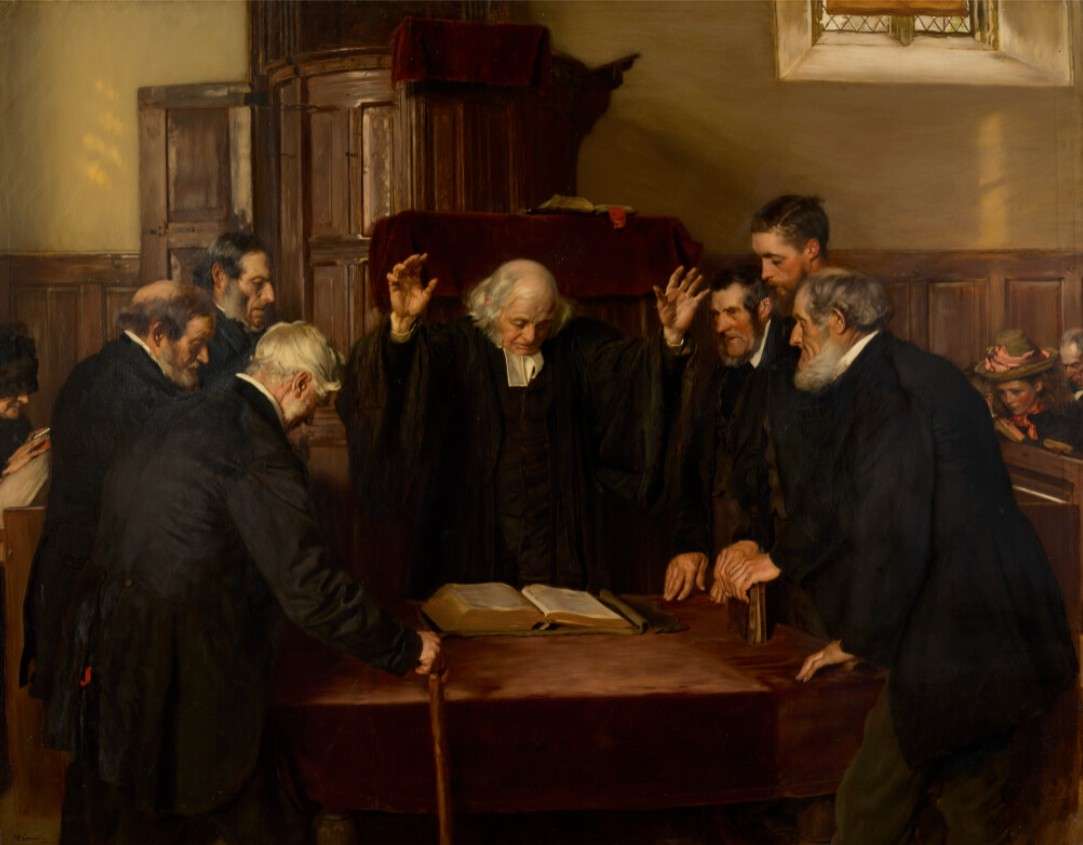
Hero artwork: John Henry Lorimer, The Ordination of Elders in a Scottish Kirk (1891). National Galleries of Scotland, NG 1879. Wikimedia Commons, public domain in the U.S.



You must be logged in to post a comment.