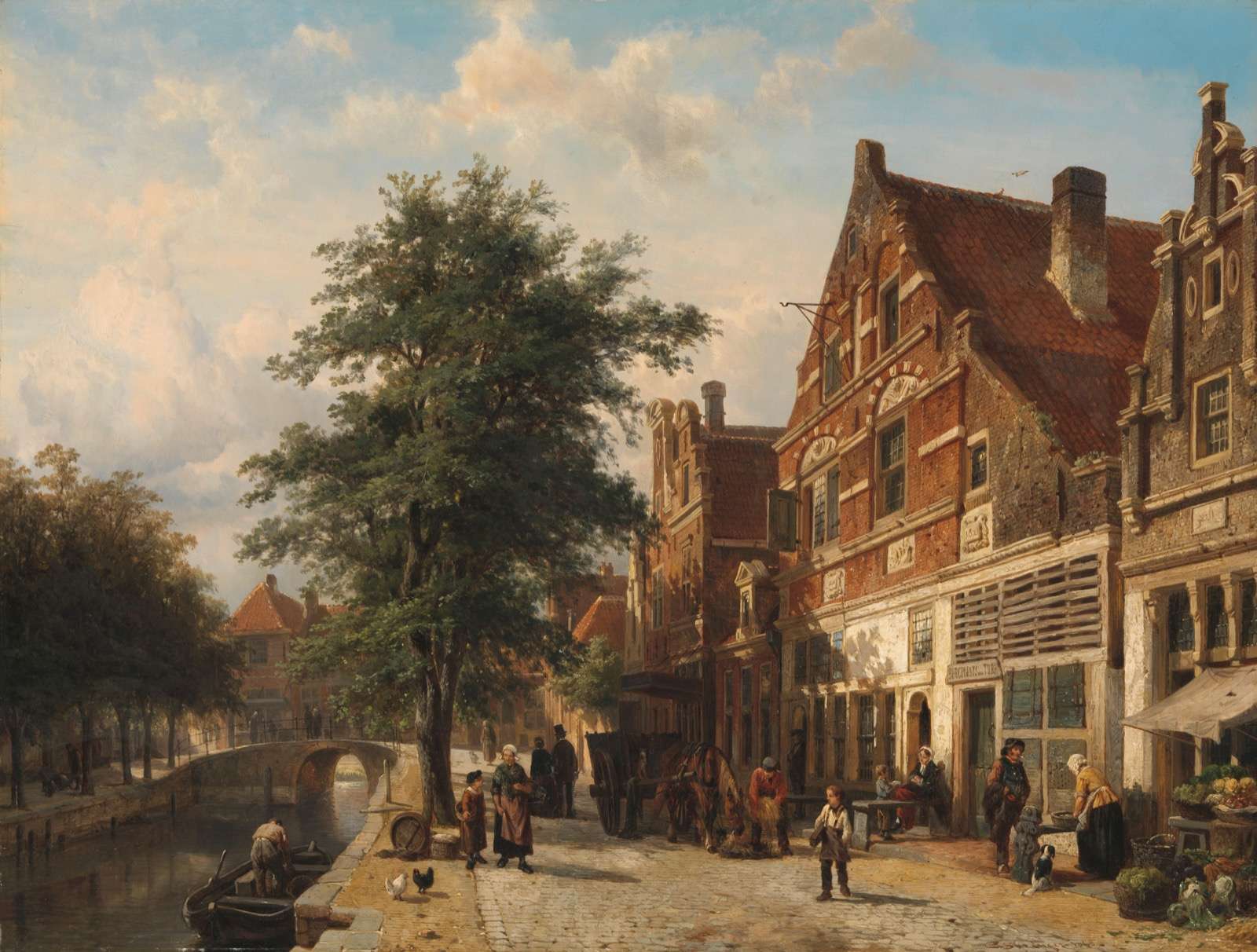
Over the last two decades, the English-speaking church has discovered the truth in the oft-repeated saying: “If you ain’t Dutch, you ain’t much.” The works of Dutchmen such as Abraham Kuyper, Herman Bavinck, and Geerhardus Vos line the shelves of Reformed (and even non-Reformed) church officers and members, with new translations arriving every year.
Though long dead, these men continue to enliven believers’ faith by directing their minds and hearts to the sovereign God who reigns over all creation and is restoring all things in Christ. Because Christ is King, they contended, Christians must not retreat from the modern world God has placed them in. Rather, amidst the rising tide of secularism, they should stand firmly on the Scriptures and the Reformed confessions while seeking to serve God in every sphere of life. One should live out their faith in public, not just in private. In other words, we ought to live every minute coram Deo—before the face of God.
This theological vision—retrieving and developing Reformed orthodoxy for the sake of speaking to and living in our modern age—came to be known as neo-Calvinism. This article introduces this rich tradition by defining the movement, identifying its key figures, and introducing a few central themes and implications for the Christian life.
Definition of Neo-Calvinism
According to leading scholars Cory Brock and Gray Sutanto, neo-Calvinism is a theological movement that emerged in the Netherlands in the late nineteenth and early twentieth centuries and sought “the critical advancement of Reformed orthodoxy for the sake of modern life.”1 This definition reflects and illuminates the two components of the term: “neo-” and “Calvinism.”
Concerning the latter, first-generation neo-Calvinists were avowedly Reformed. They fully subscribed to the Dutch Reformed confessional documents and consciously connected to, and were shaped by, the thought of the Reformed theologians of the sixteenth and seventeenth centuries.2 At times, however, they preferred the term “Calvinist” to “Reformed.” Bavinck argued that “Calvinist” was broader in scope and “stands for that characteristic view of life and the world as a whole” that emerged from the mind of John Calvin.3 As they understood it, Calvinism is a distinct, holistic worldview that applies the principles of God’s Word to everyday life.
At the same time, neo-Calvinists did not want to replicate the Reformer’s work in minute detail. As Brock and Sutanto argue, they “were self-conscious that their retrieval signaled something new, as they were motivated by the distinct questions of the modern age.”4 The nineteenth-century Netherlands faced new questions, challenges, and ideas that were unknown in sixteenth-century Switzerland. Rather than retreat from those challenges, neo-Calvinists confronted them directly, offering biblical answers in the philosophical idiom of their day. Nor did they shun modernity’s scientific and technological blessings; they accepted them as good and perfect gifts from the Father of lights (Jas. 1:17).5 Neo-Calvinism is therefore shorthand for being thoroughly orthodox, yet consciously modern.
Key Figures of Neo-Calvinism
Neo-Calvinism arose amid a rapidly changing age from the heads, hearts, and deeds of faithful Dutch Christians, especially Abraham Kuyper (1837–1920) and Herman Bavinck (1854–1921). Both contributed distinctly to the blossoming of the modern, Reformed movement in the Netherlands and beyond.
Kuyper’s mission was to remind Dutch Christians, from academics and businessmen to mothers in the home, that God is sovereign over all of life and they are to glorify God in every earthly task. After a decade of pastoral ministry, he founded two newspapers, served in Parliament, wrote numerous books and articles, established and taught theology at the Free University of Amsterdam, broke away from the national church to begin a new denomination, and eventually became Prime Minister of the Netherlands.
Kuyper put big ideas into action, while his friend and colleague Bavinck elevated “those insights to great refinement.”6 Bavinck taught theology and ethics at the Theological School in Kampen for nearly 20 years, and eventually, at Kuyper’s request, taught at the Free University until the end of his life. He made his mark not only in theology but also in psychology and pedagogy, and he was a member of the First Chamber of the Dutch Parliament.
Kuyper was neo-Calvinism’s founder; Bavinck its dogmatician. They are inseparable and, as neo-Calvinist historian George Harinck notes, “together they stand for neo-Calvinism.”7 But they were not the only neo-Calvinists. Other first-generation neo-Calvinists included Geerhardus Vos, a childhood friend of Bavinck, who established the new field of biblical theology within the Reformed tradition in the United States, and Willem Geesink, who revived the long-neglected discipline of Reformed ethics at the Free University. A second and third generation of neo-Calvinists in the Netherlands and the United States developed, and at times rejected, the thought of Kuyper, Bavinck, and Geesink, such as Herman Dooyeweerd, D. H. Th. Vollenhoven, Klaas Schilder, and Cornelius Van Til.8
Central Themes of Neo-Calvinism
While its founders were academics, Neo-Calvinism was not merely an intellectual project. Its leaders sought to equip ordinary Christians in the pews to think deeply about God, themselves, and the world so that they could serve their King in their daily lives. Four central themes especially shaped that theological vision: a holistic worldview, the organic motif, the restoration of nature by grace, and common grace.
A Holistic Worldview
Worldview is perhaps the most well-known neo-Calvinist concept, but also the most misunderstood. A worldview is not, as is commonly supposed, a long list of propositions used to interpret current events or cultural debates. It certainly includes the fundamental beliefs and desires that shape how we think, act, and perceive reality.9 But these convictions are not drawn from thin air, nor is a worldview confined to the intellectual life. It arises from foundational principles of our faith and from inductive investigations of God’s creation, and enables us to answer life’s central questions and shapes how we live in the world.
Kuyper and Bavinck offered complementary approaches to worldview, but both arrived at a holistic Christian worldview. Kuyper reasoned more deductively and maintained that one’s worldview is determined by one’s understanding of man's relation to God, our fellow human beings, and the world.10 For Christians, God’s sovereignty is the starting point. As Creator and Lord, he created all people equal before him and calls us to honor his world and cultivate the various spheres of life for his glory and our good.
Bavinck’s approach was more inductive. He investigated reality and the findings of the fields of knowledge “in an attempt to discern the first principles of existence.”11 Such inquiry leads one to the metaphysical, epistemological, and ethical ideas that undergird God’s creation, which then supply answers to such questions as “What am I? What is the world, and what is my place and task within this world?”12 Bavinck maintained that the Christian worldview alone coherently answers these questions and explains the holistic, unified relations between God, self, and the world.
The Christian worldview is fundamentally holistic. Because Christ is Lord over every square inch of creation, as Kuyper famously proclaimed, Christians engage scholarship, politics, and art with this worldview and under his authority. A Christian historian, for example, practices his discipline differently than an unbeliever. For he sees God’s hand at work in both great and small events and interprets them in light of his providential plan. Likewise, the Christian does not see civil government as a necessary evil as some unbelievers do, but as a gift from God instituted for upholding justice, restraining sin, and pursuing the common good. Therefore, to have a Christian worldview is not merely affirming certain convictions. Rather, we submit every thought, word, and deed in every sphere of life under his mighty rule.
Organic Creation
Another neo-Calvinist emphasis, which flows from its organic worldview, is seeing all of reality as an organic whole. Because creation is a revelation of its Creator, its unity and diversity reflect His triune being. God created a whole cosmos composed of diverse creatures, plants, and social spheres, each with its own God-given nature and particular norms to guide it toward its proper ends. Yet this varied world is interconnected, with every part wisely ordered within his plan and oriented toward one ultimate purpose: to glorify the Triune God.13
To truly grasp the nature of reality, one will learn to refer all of life to God. For as Bavinck wrote, “The Christian mind remains unsatisfied until all of existence is referred back to the triune God, and until the confession of God’s Trinity functions at the center of our thought and life.”14 All of creation, including the entirety of man’s being, thinking, and doing, is derived from God, is to be ruled by God and his law, and is to be directed toward its purpose of glorifying God. For he gives all things their unity, meaning, and foundation.
Grace Restores Nature
A third distinctive of neo-Calvinism is the answer it provides to the question of the relation between nature and grace. How does God’s redeeming work relate to (fallen) creation? How are Christians to relate to the world? Contrary to views that assert that the created order is evil in itself or that it is merely good in need of an ontological elevation through supernatural grace, neo-Calvinists insist that grace restores nature.
Sin has certainly polluted every crack and crevice of creation, such as the family and human nature itself. But we proclaim that everything God created is “very good” (Gen. 1:31) and “remains the work of the Father, the Creator of heaven and earth.”15 Because sin does not belong to the essence of created things, it can be removed, and the whole creation can therefore be redeemed.
God’s grace is opposed only to sin, not to the natural itself, and extends as far as the curse if found. For Christ did not come to destroy the work of the Father, but “the works of the devil. But more than that, he came to restore the works of the Father and so to renew man according to the image of him who first created man.”16 He rescues creation and its spheres from destruction, purifies it, and restores it to its intended design.
Therefore, Christians need not disdain what God created, nor flee from his world. Our faith must enliven life outside the institutional church. For, as Bavinck reminds us, “The gospel is a joyful tiding, not only for the individual person but also for humanity, for the family, for society, for the state, for art and science, for the entire cosmos, for the whole groaning creation.”17 We should value the natural and sanctify every aspect of creation by bringing it under the lordship of Christ so that it operates according to God’s will. As we do so, we witness to the Kingdom of God, which will be fully consummated at Christ’s return.18 At that time, all things will be completely restored, brought to their highest glory, and united under Christ the King.
Common Grace
If sin has marred all of creation, why does goodness remain in the world? How can unregenerate people nevertheless do good to their neighbors, and how can Christians participate in the public square alongside unbelievers? For neo-Calvinists, the answer lies with common grace, which restrains the effects of sin and preserves the created order.
The fall brought significant disorder to the world and to humanity. By nature, man is in rebellion to God; our thinking and willing no longer, in principle, submit to his law (Rom. 8:7). He is “utterly indisposed, disabled, and made opposite to all good, and wholly inclined to all evil,” as the Westminster Confession of Faith aptly states (6.4). Creation itself bears evidence of this curse (Gen. 3:18).
Yet God did not abandon his world to experience the full destructive power of sin. Out of his abundant grace, God continued to reveal himself and provided Adam, Eve, and their descendants with many good gifts, including life, work, food, children, and clothing (Gen. 3:14–21). Neo-Calvinists understand these gifts to be a result of God’s common grace, which he interposed “between sin and the creation—a grace that, while it does not inwardly renew, nevertheless restrains and compels.”19 This restraining grace manifests God’s forbearance and serves an eschatological purpose. For God curbed sin’s effects in the human heart and body, the natural world, and human society to make way for the redemptive work of our Triune God.20
The fruits of common grace are everywhere. Our unbelieving friends give to the poor, remain faithful to their spouses, and work diligently. The good evident in their lives is due to the Spirit’s work in all of creation, not to any inherent goodness within them. Neo-Calvinist thinkers also recognized that Christians can learn from unbelieving thinkers despite their rebellion against God since common grace allows them to reflect upon God’s creation and speak truth.21
Common grace also calls Christians to faithfully engage in the public square. We cannot repudiate what God has created and loves. Christ does not command us to flee the world. His work didn’t cancel out the Father’s work at creation but restores and preserves it.22 Each one of us is called to be faithful in the particular calling he has given us (1 Cor. 7:17), whether that be in the home, at school, in the workplace, or even in the state legislature. As we do so, we glorify the one who blesses us with every “good and perfect gift” (Jas. 1:17).
Conclusion
The thought and work of Kuyper, Bavinck, and other neo-Calvinists should inspire Christians today to be grounded in the Word of God and live out their worldview in their daily lives. Christ does not call us to abandon the world, nor to reject the blessings he has given us in our own day. For he preserves and is restoring every square inch of creation to its intended purpose, and we are to receive it with thanksgiving. Every moment of our day—at home, at work, at school, and even in the voting booth—should be ordered by his Word and lived coram Deo for his glory.
Footnotes
- Nathaniel Gray Sutanto and Cory C. Brock, “Editorial Introduction,” in T&T Clark Handbook of Neo-Calvinism, ed. Nathaniel Gray Sutanto and Cory C. Brock (New York: Bloomsbury, 2024), 1. Throughout this article, I draw heavily on the recent scholarship of the “Edinburgh school,” including the work of scholars such as Brock, Sutanto, James Eglinton, Cameron Clausing, and Greg Parker, Jr. ↩︎
- Herman Bavinck, “Modernism and Orthodoxy,” in On Theology: Herman Bavinck’s Academic Orations, ed. and trans. Bruce R. Pass (Leiden: Brill, 2021), 156. ↩︎
- Herman Bavinck, “The Future of Calvinism,” trans. Geerhardus Vos, The Presbyterian and Reformed Review 17 (1894): 3. ↩︎
- Cory C. Brock and N. Gray Sutanto, Neo-Calvinism: A Theological Introduction (Bellingham, WA: Lexham Press, 2023), 16. ↩︎
- Bavinck, “Modernism and Orthodoxy,” 152. ↩︎
- James Eglinton, “Herman Bavinck,” in T&T Clark Handbook of Neo-Calvinism, ed. N. Gray Sutanto and Cory C. Brock (New York: Bloomsbury, 2024), 199. ↩︎
- George Harinck, “Herman Bavinck and Geerhardus Vos,” Calvin Theological Journal 45 (2010): 18. ↩︎
- For more on how each of these figures was a neo-Calvinist, see T&T Clark Handbook of Neo-Calvinism. ↩︎
- Jessica Joustra and Robert Joustra, eds., Calvinism for a Secular Age: A Twenty-First-Century Reading of Abraham Kuyper’s Stone Lectures (Downers Grove, IL: IVP Academic, 2021), 6–7. ↩︎
- Abraham Kuyper, Lectures on Calvinism, 1st Hendrickson ed, Hendrickson Christian Classics (Peabody, Mass: Hendrickson Publishers, 2008), 11. ↩︎
- Herman Bavinck, The Essential Herman Bavinck: A Reader and Commentary, ed. Gayle E. Doornbos and Nathaniel Gray Sutanto (Grand Rapids: Baker Academic, 2026), 412. ↩︎
- Herman Bavinck, Christian Worldview, trans. Nathaniel Gray Sutanto, James Eglinton, and Cory C. Brock (Wheaton, IL: Crossway, 2019), 29. ↩︎
- This four-fold definition is guided by James Eglinton’s work in Trinity and Organism: Towards a New Reading of Herman Bavinck’s Organic Motif (New York: T & T Clark International, 2012), 67-71. Bavinck defined the organic concept in “John Calvin: A Lecture on the Occasion of His 400th Birthday, July 10, 1509-1909,” trans. John Bolt, The Bavinck Review 1 (2010), 69 and in his Christian Worldview. ↩︎
- Herman Bavinck, Reformed Dogmatics, 4 vols, ed. John Bolt, trans. John Vriend (Grand Rapids: Baker Academic, 2003), 2:330. ↩︎
- Herman Bavinck, “Common Grace,” trans. Raymond C. Van Leeuwen, Calvin Theological Journal 24, no. 1 (April 1989): 60. ↩︎
- “Common Grace,” 60. ↩︎
- Herman Bavinck, “The Catholicity of Christianity and the Church,” trans. John Bolt, Calvin Theological Journal 27 (1992): 224. ↩︎
- Brock and Sutanto, Neo-Calvinism, 162. ↩︎
- “Common Grace,” 51. ↩︎
- Brock and Sutanto, Neo-Calvinism, 214. ↩︎
- Abraham Kuyper, Lectures on Calvinism, (Peabody, MA: Hendrickson Publishers, 2008), 108. ↩︎
- “Common Grace,” 60. ↩︎