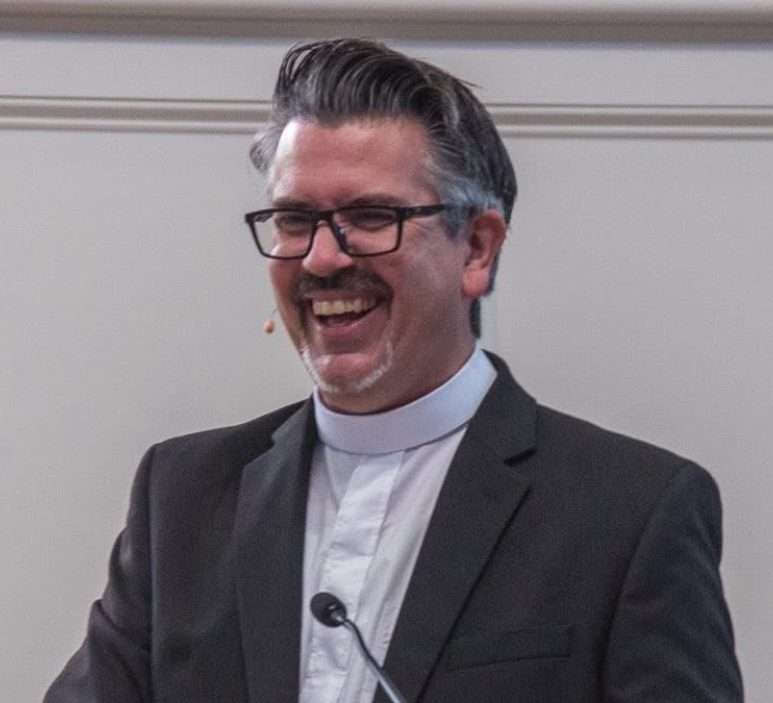
We’re thrilled to bring you this insightful conversation with Dr. Daniel R. Hyde, pastor of Oceanside United Reformed Church and author of Welcome to a Reformed Church: A Guide for Pilgrims. Dr. Hyde joined us to share his story, his theological insights, and a deep dive into Reformed worship and sacraments. Let’s get into it!
Meet Dr. Daniel R. Hyde
“First and foremost, I belong body and soul, in life and death, to Jesus Christ.” That’s how Dr. Hyde defines himself. But there’s more to his story.
“I’m a lifelong Southern Californian. I’ve lived in L.A., Orange County, and now sunny North San Diego, where I’ve pastored Oceanside United Reformed Church since it was founded in 2000. I’ve been married to my college sweetheart for 26 years, and we have four children, ages 20 to 12.”
Outside of ministry, Dr. Hyde’s passions include “the beach, dachshunds, 80s new wave music, and all things old: books, coins, and the ‘old world.’” He also has a deep connection to The Netherlands, which he calls his “second favorite place on Earth” after spending time there playing basketball and working on his Ph.D.
Favorite Theologian: Calvin
Who is your favorite Reformed theologian, and why?
“Hands down, John Calvin,” says Dr. Hyde. “When I first learned about the Protestant Reformation in college, his name came up, and I was told I had to read his Institutes of the Christian Religion. I loved it then, and I love it now.”
He continues: “It’s not just a comprehensive manual of Christian doctrine, but it’s rooted in biblical exegesis, ancient catholic theology, and pastoral warmth. I’d recommend people start with the English translation of his 1541 French edition, which was written for a more popular audience.”
The Inspiration Behind Welcome to a Reformed Church
What inspired you to write this book?
“When we started Oceanside URC, our core group was a bunch of ex-Calvary Chapel people who knew the Bible and ‘TULIP.’ For several years, I preached, taught Bible studies, and led new members’ classes with the goal of helping people understand who we are, where we came from, and where we’re going.”
“I searched high and low for basic introductory books for unbelievers, those totally new to a Reformed church, as well as my own people whom I needed to equip to explain to their friends what we’re all about. All of that teaching and interaction led me to write the book.”
Dr. Hyde adds, “I hope a person takes away from the book that we didn’t just start yesterday, unlike so many of our churches in SoCal! I want them to know the existential joy I had when I learned that our roots are transcendent: in the Scriptures of the Old and New Testaments, the ancient church, and the Protestant Reformation.”
What It Means to Be Reformed?
Dr. Hyde explains: “To be Reformed means we’re Christian, Protestant, and Reformed.” Here’s what that looks like:
- Christian: “We accept the Bible as the Word of God and the creeds of the ancient church. These creeds teach that we believe in the Triune God and that the Person of the Son is both divine and human. In other words, to be Christian is to be ‘catholic.’”
- Protestant: “Jesus Christ is the supreme bishop and head of the church on Earth. He exercises His rule by His Word and Spirit. We believe salvation is merely a matter of God’s grace alone, received through faith alone in Jesus Christ alone. Period. End of story.”
- Reformed: “We believe we’re just the continuation of the ancient catholic church that has been reformed according to the Word of God. Reformed also means in distinction from Lutheranism, the other branch of the Protestant Reformation.”
Worship in a Reformed Church
What can visitors expect in a Reformed church service?
Dr. Hyde describes what makes Reformed worship distinct and welcoming, particularly at Oceanside United Reformed Church:
“First, we want visitors to feel welcomed. We have a table with a welcome sign, bulletins, Bibles, and greeters as you walk in. We do this because we recognize stepping into a new church can be awkward and strange. We know that Reformed liturgy is going to be different for those from various evangelical churches, so at a minimum, we at least want people to feel like we care, and that might help ease some of the awkwardness.”
He continues, “Second, we want visitors to meet with God. When we come together in public as the church, something happens here that happens nowhere else. Heaven meets Earth; we experience heaven. Christian worship is transcendent. This is what the letter to the Hebrews teaches us when it compares and contrasts the ancient tabernacle and temple with the heavenly temple we now worship in through Christ. God speaks to us in His Word throughout the service (‘liturgy’), especially in the preached Word. Then He guarantees the promise of His Word in Holy Communion. In response, we offer up ourselves to Him in prayer and song.”
“Third, our liturgy is saturated with and shaped by Scripture. What we mean by the ‘regulative principle of worship’ is that we do in worship what God requires of us in His Word. Every church has a liturgy, and we want people to know that we’re mindful and honest enough to let you know upfront that we’ve thought through this from the vantage point of Scripture.”
What about instruments in worship?
“Yes, we believe God has given the gift of music, instruments, and the human voice which blend together in praise to Him. Currently, we have a pianist and keyboard organist, two guitarists, a cajón player, as well as several singers who help us praise God.”
For more, check out Dr. Hyde’s book What to Expect in Reformed Worship: A Visitor’s Guide and the article Why Worship Is Better Under the New Covenant (Hebrews 10:19-22).
A Reformed Understanding the Sacraments
Do Reformed Christians believe in Christ’s “true presence” in the Lord’s Supper?
“Yes. Obviously, this was probably the most intense and thorny question of the Protestant Reformation. From the vantage point of being Reformed, we agree with Rome, Orthodoxy, and Lutheranism that Christ is present in the Lord’s Supper and that this is a mystery. The disagreement is how.”
Dr. Hyde elaborates further: “In simplistic terms, Rome says bread and wine are changed (‘transubstantiated’) into flesh and blood. Orthodoxy says bread and wine become flesh and blood without the philosophical explanation of transubstantiation. Lutheranism agrees with Orthodoxy but says Christ is present ‘in, with, and under’ the bread and wine. The Reformed view agrees Christ is present and His words are to be taken seriously, but we see this presence as a spiritual mystery.”
He sums it up with Calvin’s words: “It’s better to experience than understand” (Institutes 4.17.32).
Why Baptize the Infants of Believers?
Dr. Hyde, your book Jesus Loves the Little Children: Why We Baptize Children presents a fascinating argument for infant baptism. Can you summarize the core of your argument for our readers?
Dr. Hyde: My basic argument to evangelicals is this: you already believe in infant baptism; you just don’t know it. Think about it: if you take your child to church because that’s what Christians do, if you’ve had your child dedicated in a church service, if you pray with your child and have them pray, if you read the Bible with them and have them read it, or if you homeschool or put your child in Christian school to teach them the Christian faith, ask yourself why?
The answer is that you believe your children are different from the children of unbelievers. The Bible teaches that children of believers belong to the “covenant” or people of God. This concept is rooted in Scripture, appearing in both the Old and New Testaments. Let me explain.
Can you elaborate on how this concept is supported in Scripture?
Dr. Hyde: Certainly. In the Old Testament, we see this principle repeatedly. Take Noah, for example. His wife, sons, and daughters-in-law were included in the Ark because of Noah’s faith. Abraham was given God’s promises and commanded to circumcise himself and all the males in his household because they were included in the covenant. Notably, Abraham was circumcised after he believed, but his son Isaac was circumcised before, as he was already included in the covenant.
The inclusion of children extends to the nation of Israel. Israelites were commanded to circumcise their eight-day-old boys because they belonged to the covenant. Israel’s children passed through the Red Sea, ate manna, drank water from a rock, and entered the Promised Land because they were part of the covenant people.
When we come to the New Testament, this inclusion is assumed and never revoked. Consider Jesus blessing the little children. Why? Because they belong to the kingdom of God. In fact, Jesus told his disciples to emulate these children, relying on him fully.
What about the practice of baptism in the New Testament? How does it align with this covenantal concept?
Dr. Hyde: In the book of Acts, we see households being baptized because of one person’s faith. For example, in Acts 16, Cornelius and his household were baptized. This included everyone living in his home: extended family and servants. The pattern mirrors the Abrahamic covenant in Genesis: “you, your sons, and your household.”
Paul’s letters also support this view. In Ephesians 6, Paul directly addresses children in the congregation, commanding them to obey their parents “in the Lord.” This command is rooted in the fifth commandment, which itself is covenantal language.
How does this relate to baptism as a covenantal sign?
Dr. Hyde: Baptism is the outward sign of belonging to God’s covenant, just as circumcision was in the Old Testament. There are differences, of course. In the Old Testament, only boys were circumcised, and it occurred on the eighth day. In the New Testament, with the coming of the gospel, distinctions between Jew and Gentile, slave and free, male and female are removed. Now, all children and household members can receive the sign of baptism, reflecting the newness of the new covenant.
This continuity between the Old and New Testaments underscores why we baptize children. They belong to the covenant people of God, and baptism is the outward sign of that belonging.
Contemporary Challenges Facing the Reformed Church
What is the biggest challenge Reformed churches face today?
“As a Reformed pastor, how do we stay faithful to our confessions while at the same time applying them to new challenges is always our challenge. We need to engage in the spiritual warfare against the idols of our age, deal with day-to-day apologetics, appeal to the unbeliever’s sense of divinity, catechize our kids, equip our members, and the list goes on.”
“I don’t know about the most pressing challenge since being a pastor feels like Neo in The Matrix battling hundreds of Agent Smith’s. The battles never end and they come from all sides. I would say as a Reformed pastor in a particular federation of Reformed churches, how do we stay faithful to our confessions while at the same time applying them to new challenges is always our challenge.”
“As a minister in the URCNA that came out of the CRCNA, we can look back upon the examples of the old Gereformeerde Kerken in Nederland and men like Abraham Kuyper and Herman Bavinck for examples of how this is possible. We come out of the Neo-Calvinist branch of the Dutch Reformed churches, which believes we are to be confessional and contemporary. This means, for example, we can’t just assert the existence of God, although we believe everyone knows God exists (Romans 1).
“We need to recognize the philosophical waters we all swim in and take for granted: radical skepticism on the one hand and radical confidence in the self on the other. Our self-centeredness is our god as Americans. “Life, liberty, and the pursuit of happiness” is our religion as we assume and seek to be the creators of our own reality. We not only need to confess the biblical teaching of what’s in Belgic Confession article one, we need to engage in the spiritual warfare against the idols of our age, deal with day-to-day apologetics, appeal to the unbeliever’s sense of divinity, catechize our kids, equip our members, and the list goes on. And that’s just one Agent Smith!”
Wrapping Up
Tell us about your latest projects.
“My most recent book is This is the Word of the Lord: Becoming Confident in the Scriptures (Christian Focus, 2022). It equips readers to trust Scripture as God’s Word and ultimate authority.”
As for what’s next, Dr. Hyde has three projects in the works:
- His Ph.D. dissertation on John Owen’s eschatology and liturgy.
- A commentary on Hebrews for The Hodder Bible Commentary series.
- A book on the biblical theology of God’s presence.
How can readers stay connected?
“People can follow me on Amazon, Facebook, and Twitter for updates on my books and ministry.”
We hope you enjoyed this deep dive into Reformed theology, worship, and the sacraments. Don’t forget to check out Dr. Hyde’s work and share this article with others who might find it helpful!