A recent discussion on X about a theological book cover raised a question that seems to come around every Holiday season. Reformed Christians objected to its picture of Christ. Roman Catholic participants raised an objection worth considering: because God became man, depicting Christ does not violate the Second Commandment. If God made himself visible at the Incarnation, why should Christians refuse to portray him?
That honest question deserves a careful answer. Jesus truly became one of us. Yet I believe that his becoming visible didn’t give us permission to make pictures of him.
The confessional Reformed position is clear: we must not make images of God, including Christ, or worship him through images. We must worship him only as he commands in his Word (Heidelberg Catechism 96-98; Westminster Larger Catechism 109).1 This teaching rests on Exodus 20:4-6; Deuteronomy 4:15-19; Acts 17:29; and Matthew 15:9.
Taking the Catholic Argument Seriously
The Catholic Catechism puts their view like this: “By becoming incarnate, the Son of God introduced a new ‘economy’ of images.”2 Catholics argue that a picture can show Christ’s real human body without pretending to capture his divine nature.
Thomas Aquinas states the conclusion directly: “But because in the New Testament God was made man, He can be adored in His corporeal image.”3 Benedict XVI likewise connects the defense of icons with “faith in that God who became flesh and was made visible.”4
Catholic teaching doesn’t say that paint becomes God. It distinguishes veneration, or honor shown to images, from the worship owed to God alone. That honor is directed to the person represented. We disagree about whether God has authorized this practice.
The disagreement also crosses Protestant lines: Lutherans generally allow images of Christ, and some appeal to the Incarnation in their defense.5
What the Commandment Forbids
It’s true that God commanded golden cherubim and a lampstand decorated with almond blossoms (Exodus 25:18, 31-36). This shows He doesn’t forbid all art. But Deuteronomy 4:15-19 warns Israel against making an image to represent the God whose voice they heard at Horeb.
A modern photograph depicts a created person who bears God’s image; it doesn’t depict God himself (Genesis 1:26-27). Christ, however, is the eternal Son of God. A picture intended to portray him has a different subject from a picture of me.6
Good intentions are not enough. Aaron announced “a feast to the LORD” (Exodus 32:5), but the Lord’s name did not make the golden calf acceptable. Even the bronze serpent God commanded was destroyed when people made offerings to it (Numbers 21:8-9; 2 Kings 18:4).
What Changed When God Became Man?
Israel saw no form at Horeb, but the disciples did see Jesus. The Second Helvetic Confession addresses that difference:
Although Christ assumed human nature, yet he did not on that account assume it in order to provide a model for carvers and painters.7
Second Helvetic Confession, chapter 4
Francis Turretin explains why seeing God does not give us permission to make an image of him:
Although God sometimes manifested himself in a visible form and in such an appearance is described to us in Scripture (when members and bodily actions are ascribed to him), it does not follow that it is lawful to represent him by an image.8
Francis TurretinInstitutes of Elenctic Theology
After Christ’s resurrection, Paul continued to reject the idea that the divine being resembles something fashioned by human art (Acts 17:29). He was addressing pagan idols, so this passage alone cannot settle every question about Christian portraits. In this speech, he called his hearers to repent and proclaimed the risen Christ (Acts 17:30-31). He did not tell them to replace pagan idols with images of Jesus.
Can We Picture Only His Humanity?
The commandment concerns the one true God, not the Father alone. The Son shares the divine nature with the Father and the Spirit. Becoming man didn’t make him less than God.
Louis Berkhof describes God’s being as “immaterial, invisible, and without composition or extension.”9 This concerns God’s divine nature; it does not deny Christ’s real human body.
Jesus is one divine person with two distinct natures. Harrison Perkins writes, “Those who walked on earth with Jesus encountered the full person of the Son.”10 They encountered him in his humanity, without seeing his divine essence.
A Catholic can agree and argue that a portrait represents that person through his humanity. We shouldn’t dismiss the argument by saying every artist is trying to paint divinity. But the person the picture represents remains the Son of God. His humanity does not, by itself, establish permission to portray him.
How Christ Gives Himself to His Church
The apostles gave the church their testimony about Jesus, whom they had heard, seen, and touched (1 John 1:1-3). Paul set Christ before the Galatians through preaching (Galatians 3:1-5). Jesus appointed teaching and the sacraments for his church (Matthew 28:19-20; 1 Corinthians 11:23-26).
Water, bread, and wine show that the issue is not whether material things can serve God. Their use rests on Christ’s command.
The Heidelberg Catechism states the principle:
Q. What does God require in the second commandment?
A. We are not to make an image of God in any way, nor to worship him in any other manner than he has commanded in his Word.11
Aquinas appeals to unwritten apostolic tradition to defend image worship.12 Reformed Christians require the authority of the apostolic Word. Jesus warned that tradition can make void God’s Word (Mark 7:13).
Perkins observes, “Because remembering Christ leads us to worship Him,” images cannot be treated as religiously neutral.13 Their subject is the Savior we adore.
Where Reformed Teachers Disagree
Westminster Larger Catechism 109 forbids making representations “of all or of any of the three persons.” It forbids making these images even when no one worships them.
I was really surprised to see Herman Bavinck say, “I would not dare to prohibit these,” when discussing paintings and sculptures of Christ.14 He opposed image worship, but didn’t reject every illustration. Bavinck’s position may deserve an article of its own.
R. C. Sproul also defended depicting Christ’s humanity: “But I can distinguish between the two natures without separating them.”15
We agree that Christ’s two natures are distinct, but we must not separate them. R. Scott Clark writes, “It is not possible to separate his humanity from his deity and have Christ.”16
Sproul also rejects separation. The disagreement is whether portraying Christ’s humanity avoids it. I value these teachers, but follow our confessions here.
Five Common Objections Answered
1. Where does the Bible forbid a picture of Christ on a book?
No verse mentions book covers. Start with Deuteronomy 4:15-19, read alongside Exodus 20:4-5. Moses forbids giving God a created likeness, including a human one. Christ is the divine Son, not a merely human subject (John 1:1, 14).
That’s why Reformed Christians apply this commandment to pictures of Christ. We are applying the Bible’s teaching to a modern example.
2. Didn’t the Incarnation change things?
Yes, the Son truly became a man (John 1:14). Catholics are not saying the commandment vanished; they believe the Incarnation changed what it allows. Reformed Christians agree that people could see Jesus, but don’t believe that this gave us permission to make pictures of him.
However sincere the effort, a face we invent is a counterfeit likeness of the real Christ. We don’t need an imitation of him in our minds. A good imagination is still a poor eyewitness.
3. Wouldn’t this forbid my profile picture too?
A profile picture portrays a creature, not the Creator. Being made in God’s image does not make us God (Genesis 1:26-27). God’s command to make cherubim confirms that he did not forbid every image of a created thing (Exodus 25:18).
4. What if the picture is only for teaching?
The intended subject is still the Son of God. Westminster Larger Catechism 109 forbids making his image, even without bowing before it. The Heidelberg Catechism addresses using images to teach the church:
Q. But may images not be tolerated in the churches as “books for the laity”?
A. No, for we should not be wiser than God. He wants his people to be taught not by means of dumb images but by the living preaching of his Word.17
Dumb here means unable to speak.
5. Can’t the picture represent his humanity alone?
Scripture gives us one Christ with two natures (John 1:1, 14). We distinguish those natures; we don’t divide him into two persons, the error called Nestorianism. His humanity belongs to God the Son, never to a separate human person. Appealing to his humanity doesn’t change who the picture represents or remove our confessions’ objection.
Loving Christ Until We See Him
A familiar picture may be tied to childhood or someone’s first lessons about Jesus. We should speak patiently and avoid judging every illustrator’s motives.
Through his Word, Christ tells us who he is and how freely he receives sinners. His Spirit unites us to him, and his sacraments confirm his promises. We don’t need to supply a face to make those promises personal.
Peter describes believers who love Christ without seeing him (1 Peter 1:8). One day we will see him as he is (1 John 3:2). Until then, we can trust what he has given us.
Footnotes
- Heidelberg Catechism, Q&A 96-98; Westminster Larger Catechism, Q&A 108-109. ↩︎
- Catechism of the Catholic Church, 476-477, 2131-2132. ↩︎
- Thomas Aquinas, Summa Theologiae III.25.3, reply to objection 1. ↩︎
- Benedict XVI, “John Damascene,” May 6, 2009. ↩︎
- Lutheran Church-Missouri Synod, Indiana District, “The Image of Christ Jesus Portrayed Before Your Eyes.” ↩︎
- Genesis 1:26-27; Heidelberg Catechism, Q&A 97; Westminster Confession of Faith 8.2. ↩︎
- Second Helvetic Confession, chapter 4, “Images of Christ.” ↩︎
- Francis Turretin, Institutes of Elenctic Theology (P&R, 1994), 2:65 (11.10.IX). ↩︎
- Louis Berkhof, Systematic Theology, “The Spirituality of God.” ↩︎
- Harrison Perkins, “Images of Christ and the Vitals of the Reformed System,” The Confessional Presbyterian 14 (2018): 208. ↩︎
- Heidelberg Catechism, Q&A 96. ↩︎
- Aquinas, Summa Theologiae III.25.3, reply to objection 4. ↩︎
- Perkins, “Images of Christ,” 205. ↩︎
- Herman Bavinck, Reformed Ethics, vol. 2 (Baker Academic, 2021), chapter 15, section 33, “Analysis,” 1(ii), Logos edition. ↩︎
- R. C. Sproul, “Questions and Answers #1,” Ligonier’s 2014 National Conference, 50:58. ↩︎
- R. Scott Clark, reply to Dennis on “Heidelcast 52: Images Of Christ Don’t Affirm His Humanity, They Deny It,” December 2, 2013. ↩︎
- Heidelberg Catechism, Q&A 98. ↩︎
Further Reading
For Perkins’s fuller biblical and theological argument, see Images of Christ and the Vitals of the Reformed System.
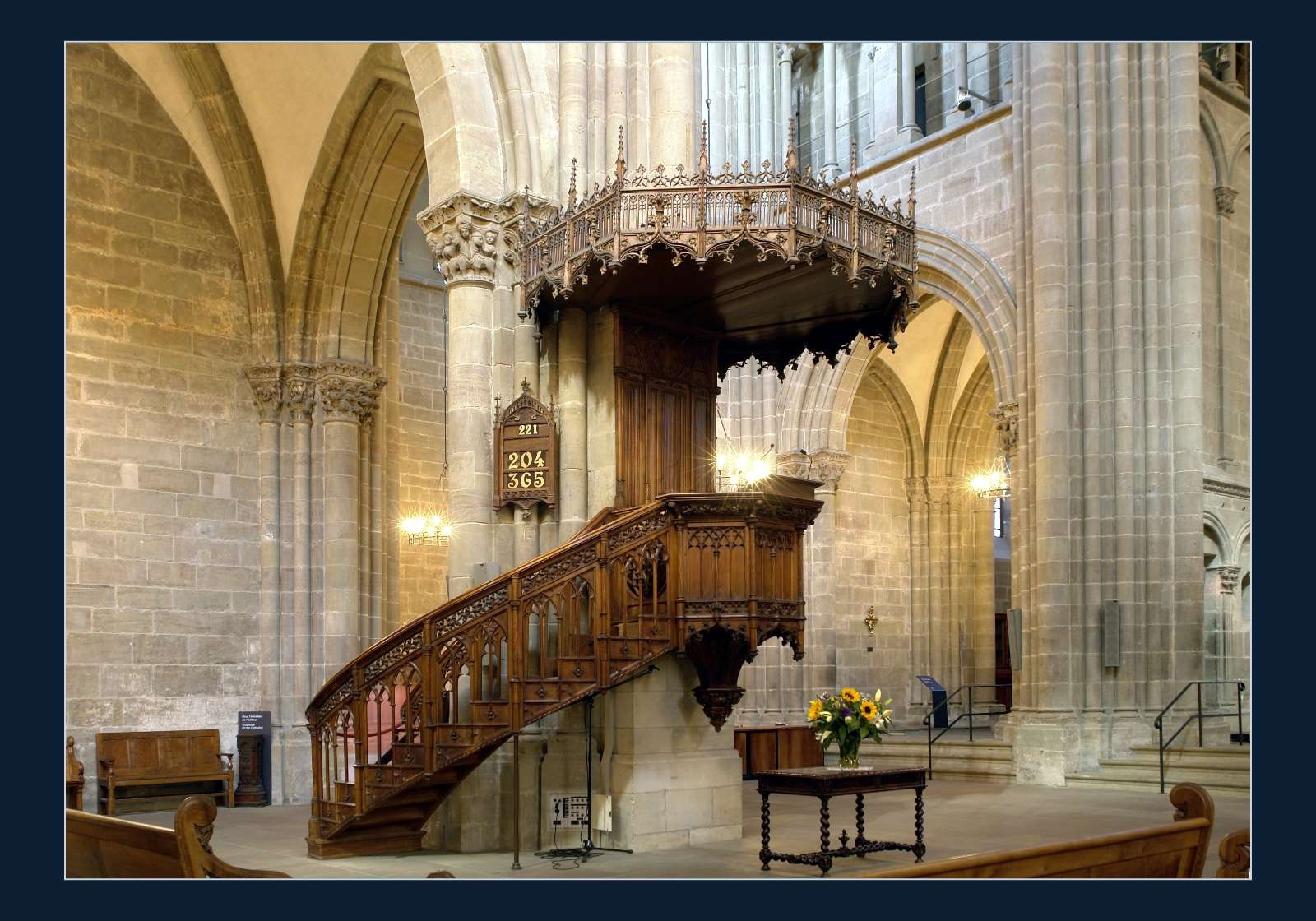
Photograph: The pulpit of Saint-Pierre Cathedral, Geneva. © Yann Forget / Wikimedia Commons, CC BY-SA 4.0. Proportionally resized with a navy surround; the social card uses a crop.