


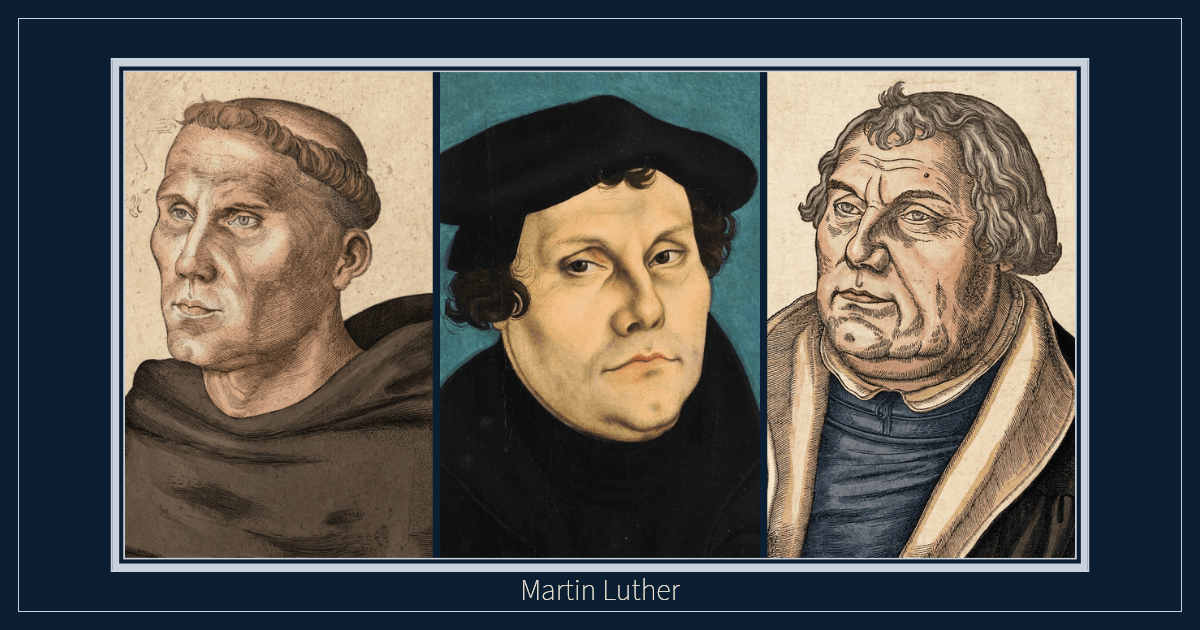
In 1523, a younger Martin Luther wrote tenderly of the Jews as “blood relatives, cousins, and brothers of our Lord,” and he pleaded with Christians:
“I would request and advise that one deal gently with them and instruct them from Scripture; then some of them may come along.”
Twenty years later, the same hand drafted an eight-point program for the burning of synagogues, the razing of homes, the confiscation of property, and the expulsion of every Jew from German lands.1
This is not a tale of two men, but the story of a sinner and saint. The Reformer who recovered the doctrine of justification by faith alone was also a man capable of writing some of the worst things in the history of Christian polemics against the Jewish people.
Luther was the hero of Worms and the author of Against the Robbing and Murdering Hordes of Peasants. He was the theologian behind the Heidelberg Disputation, who taught the church to see God under the cross, and he was the curmudgeon at Wittenberg who counseled magistrates that “a prince can win heaven with bloodshed better than other men with prayer.”2
How does a Reformed Christian hold all of these contradictions together? We don’t soften the ugly, and we don’t erase the good. Reformed theology has the categories to read Luther honestly because the truth of the gospel he recovered never rested on the holiness of the man who recovered it.
What follows takes the good, the bad, and the ugly in order. The good is the gospel Luther recovered. The bad is what his temper did in middle age, splitting the church at Marburg and blessing slaughter in the Peasants’ War. The ugly is what his temper wrote against the Jews in his last years, and the Confessional Reformed reckoning we owe in our inheritance from him.
The Good

Luther entered the Augustinian monastery at Erfurt in July 1505 as a man desperate to make himself holy enough for God to accept him. Late-medieval Christianity offered a sinner a sacramental vending machine for managing guilt: confession, penance, and indulgence. The machine never told a man he had done enough, because by Rome’s logic he never had.
Luther’s conscience was a mess, and he knew he needed forgiveness, but he didn’t know how to get it. He fasted, prayed, kept vigils, and confessed for hours at a time, but none of it gave him peace with God. Years later he described what that time felt like from the inside:
Though I lived as a monk without reproach, I felt that I was a sinner before God with an extremely disturbed conscience. I could not believe that he was placated by my satisfaction. I did not love, yes, I hated the righteous God who punishes sinners, and secretly, if not blasphemously, certainly murmuring greatly, I was angry with God.3
Martin Luther “Preface to the Complete Edition of Luther’s Latin Writings” (1545), in Luther’s Works, vol. 34: Career of the Reformer IV
Luther didn’t start the Reformation because he wanted to become the first Protestant Pope; he started it because the church could not tell him how to be saved.
For Luther, the gates to heaven opened with Romans 1:17. Luther had been taught to read “the righteousness of God” as the active righteousness by which God himself is just and by which he condemns the unrighteous. On that reading, the gospel was bad news for sinners. Then, by grace:
At last, by the mercy of God, meditating day and night, I gave heed to the context of the words…There I began to understand that the righteousness of God is that by which the righteous lives by a gift of God, namely by faith. And this is the meaning: the righteousness of God is revealed by the gospel, namely, the passive righteousness with which merciful God justifies us by faith, as it is written, “He who through faith is righteous shall live.” Here I felt that I was altogether born again and had entered paradise itself through open gates.4
Martin Luther “Preface to the Latin Writings,”
He had been right about the law and wrong about the gospel; now he began to properly distinguish between the law and gospel. Once Luther saw the righteousness of God as gift rather than a threat, every other Reformation doctrine fell into place.
On October 31, 1517, Luther posted his Ninety-Five Theses against indulgences. Thesis 1 sets the key: “When our Lord and Master Jesus Christ said, ‘Repent’ (Mt 4:17), he willed the entire life of believers to be one of repentance.”5 In April 1521, he refused to recant before Charles V at the Diet of Worms, on the ground that his conscience was captive to the Word of God. Three years before Worms, in 1518, he produced what may be the most concentrated theological statement of his early career, the Heidelberg Disputation. Its middle theses are where the Reformation lives:
19. That person does not deserve to be called a theologian who looks upon the invisible things of God as though they were clearly perceptible in those things which have actually happened.
20. He deserves to be called a theologian, however, who comprehends the visible and manifest things of God seen through suffering and the cross.
21. A theologian of glory calls evil good and good evil. A theologian of the cross calls the thing what it actually is.6
Martin Luther “Heidelberg Disputation” (1518), in Luther’s Works, vol. 31
A theology of glory looks for God in power and success. A theology of the cross looks for God where he has hidden himself: in weakness and suffering, supremely in Jesus on a Roman cross outside Jerusalem.
In 1525, Luther answered Erasmus’s defense of free will with The Bondage of the Will. At the end of it, he paid Erasmus an extraordinary compliment:
You, and you alone saw, what was the grand hinge upon which the whole turned, and therefore you attacked the vital part at once; for which, from my heart, I thank you.7
Martin Luther The Bondage of the Will, trans. Henry Cole (1823)
It sounds sarcastic, but Luther meant it. He thanked Erasmus for getting to the real issue, which was the bondage of the human will under sin and the sovereignty of God in salvation. This was the DNA of the doctrines of grace. The Canons of Dort (3.3) on total depravity, the Westminster Confession of Faith 9.3 on the freedom of the will, and the Heidelberg Catechism Q&A 8 on human inability all say in their own words what Luther said in his: the will is bound in sin, God’s grace is monergistic, and Christ alone saves.8
As some of you know, I was baptized and confirmed in the Lutheran church, and the first book that ever made me suspect my Lutheran pulpit had drifted from its own Reformer was Bondage of the Will. Young Luther meant a great deal to my developing faith. I’m still in debt to his early writings on the gospel: The Freedom of a Christian, Two Kinds of Righteousness, and the Heidelberg Disputation.
One line from The Freedom of a Christian still holds me: “A Christian is a perfectly free lord of all, subject to none. A Christian is a perfectly dutiful servant of all, subject to all.”9 Saying what he got right is part of giving him his due, and a way of acknowledging how indebted Reformational Christians are to him for recovering the gospel of grace.
The Bad

The Luther of the early years is the Luther the Reformed tradition has always honored and held in high esteem. The Luther of middle age is harder. Within the same tumultuous decade, Luther was willing to break fellowship with fellow Reformer Ulrich Zwingli over a phrase and counseled German princes to “smite, slay, and stab” rebellious peasants.
In October 1529, at the invitation of Philip of Hesse, Luther and Zwingli met at Marburg Castle along with Melanchthon, Oecolampadius, Bucer, and other Reformers. Philip wanted political unity among the Protestant powers, and this required theological unity. The colloquy produced fifteen articles, now known as The Marburg Articles, covering the Trinity, the person of Christ, original sin, justification by faith, the sacraments, and civil authority.
Fourteen of the articles were signed without dispute. The fifteenth, on the Lord’s Supper, exposed a rift the colloquy could not heal. Luther chalked Hoc est corpus meum (This is my body) on the table and refused to be moved off the literal reading of the words of institution. Zwingli answered that est must be read figuratively, on the principle that the body of Christ cannot be locally present both in bread on a German altar and at the right hand of the Father at the same time.
When the articles were signed, the Swiss still hoped to be recognized as brethren. At their final meeting Zwingli approached Luther with tears in his eyes and held out the hand of brotherhood, but Luther declined it, saying, “Yours is a different spirit from ours.”10 Luther had already lumped the Reformed wing with the Schwärmer, his term for fanatics or enthusiasts, and his posture did not soften after Marburg. When Zwingli fell on the battlefield at Kappel two years later, Luther wrote in his Table Talk that “if his error had prevailed, we would have perished, and our church with us. It was a judgment of God.”11
Luther was right that the words of institution are not a mere memorial and the Lord’s Supper is a means of grace. He was wrong about the metaphysics. The Lutheran insistence on bodily real presence “in, with, and under” the elements turns on a Christology in which the human nature of Christ is ubiquitous (present everywhere).
The Reformed reply, worked out by Calvin and codified in the Consensus Tigurinus of 1549 and afterward in the Westminster Confession and the Heidelberg Catechism, refuses this collapse. Calvin himself, at Institutes 4.17.32, marks the difference with the pastoral humility that has shaped Reformed Eucharistic theology ever since:
Now, if anyone should ask me how this takes place, I shall not be ashamed to confess that it is a secret too lofty for either my mind to comprehend or my words to declare. And, to speak more plainly, I rather experience than understand it. Therefore, I here embrace without controversy the truth of God in which I may safely rest.12
John Calvin Institutes of the Christian Religion 4.17.32 (Battles)
The Westminster Confession 29.7 puts it this way: the worthy receiver “really and indeed, yet not carnally and corporally, but spiritually,” feeds on Christ crucified. The Reformed belief is that Luther was right to fight for the true presence and wrong to make bodily presence the price of fellowship. His refusal to extend the right hand at Marburg was the first public sign of a polemical posture that would harden as he aged.
Four years before Marburg, a different crisis had pressed Luther to write. In 1524, peasant rebellions broke out across southern and central Germany, drawing on Lutheran rhetoric about Christian freedom. After visiting Thuringia and seeing the violence firsthand, Luther wrote Against the Robbing and Murdering Hordes of Peasants, published in May 1525. The notorious sentence reads:
Therefore let everyone who can, smite, slay, and stab, secretly or openly, remembering that nothing can be more poisonous, hurtful, or devilish than a rebel. It is just as when one must kill a mad dog; if you do not strike him, he will strike you, and a whole land with you.
And an even harder one, three pages later:
These are strange times, when a prince can win heaven with bloodshed better than other men with prayer!13
Martin Luther Against the Robbing and Murdering Hordes of Peasants, Luther’s Works, vol. 46
That sentence is the one the Reformed Christian cannot let pass without comment. Luther is not merely permitting the magistrate to suppress an armed revolt; he’s reframing the bloodshed as soteriologically meritorious, language that puts a prince in the same theological frame as a martyr. Westminster Confession of Faith 23.1 arms the civil magistrate with the sword “for the defense and encouragement of them that are good, and for the punishment of evildoers.” It does not promise the prince heaven for killing peasants.
Marburg and Peasants are different in subject but similar in attitude. In both, Luther is in the right on at least one point of substance, in the wrong on at least one point of theological framing, and increasingly in the habit of treating disagreement as betrayal. A recovered doctrine of justification by faith does not, by itself, perfectly sanctify the tongue. Sin remains in the regenerate (WCF 6.5 & WCF 13.2). This same temper, initially directed at fellow Christians, is about to be turned in his old age against the Jews.
The Ugly

In 1523 Luther had been hopeful that if the Jews were shown the gospel without the cruelty of medieval Christianity, many would respond and convert. By the late 1530s his hope was gone. Three things had hardened him: Christian groups in Moravia had started keeping the Jewish Sabbath, which alarmed him; the wave of Jewish conversions he expected never came; and in 1537 he refused to help Josel of Rosheim, a respected Jewish leader, who had asked Luther to plead with the elector of Saxony on behalf of Jews facing expulsion. Luther’s shift was gradual, not sudden.
What unifies Luther’s late writings against the Jews is a single accusation: blasphemy. As Thomas Kaufmann argues, after 1540 Luther came to regard the Jews as a danger to church and society, a people who expressed their hatred of Christ through blasphemy and who sought, through false readings of Scripture, to draw Christians away from the faith.14
Read together, the 1538 Against the Sabbatarians and the 1543 On the Jews and Their Lies advance that one charge. Luther accused the Jews of denying Christ as Messiah, of boasting in a privileged lineage, of a demonic mastery over their own exegesis, and of willfully twisting the meaning of Scripture.
By 1543, Luther had taken up a stance that was exactly the opposite of his 1523 outlook:
Because, as I related in that book, my opinion is not to write against the Jews as I was hoping to convert them…so that we Germans know historically what a Jew is and to warn our Christians about them, as of the devil himself, and to strengthen and honor our faith; not to convert the Jews who are as possible to convert as the devil.15
Martin Luther Vom Schem Hamphoras (1543), in Gerhard Falk, The Jew in Christian Theology: Martin Luther’s Anti-Jewish Vom Schem Hamphoras
Then comes the part in the treatise that has no defense. In Part XI of On the Jews and Their Lies (1543), Luther turns from accusation to action, from what the Jews supposedly are to what should be done about them. He calls his solution “sharp mercy”:
What shall we Christians do with this rejected and condemned people, the Jews? Since they live among us, we dare not tolerate their conduct, now that we are aware of their lying and reviling and blaspheming…With prayer and the fear of God we must practice a sharp mercy to see whether we might save at least a few from the glowing flames. We dare not avenge ourselves. Vengeance a thousand times worse than we could wish them already has them by the throat. I shall give you my sincere advice.16
Martin Luther On the Jews and Their Lies, Luther’s Works, vol. 47
Luther is not framing what follows as cruelty; he is framing it as severe pastoral measure for the saving of souls.
What Luther advised, in his own words:
First, to set fire to their synagogues or schools and to bury and cover with dirt whatever will not burn, so that no man will ever again see a stone or cinder of them.
Second, I advise that their houses also be razed and destroyed.
Third, I advise that all their prayer books and Talmudic writings…be taken from them.
Fourth, I advise that their rabbis be forbidden to teach henceforth on pain of loss of life and limb.
Fifth, I advise that safe-conduct on the highways be abolished completely for the Jews.
Sixth, I advise that usury be prohibited to them, and that all cash and treasure of silver and gold be taken from them and put aside for safekeeping.
Seventh, I recommend putting a flail, an ax, a hoe, a spade, a distaff, or a spindle into the hands of young, strong Jews and Jewesses and letting them earn their bread in the sweat of their brow.
But if we are afraid that they might harm us…then let us emulate the common sense of other nations such as France, Spain, Bohemia, etc., compute with them how much their usury has extorted from us, divide this amicably, but then eject them forever from the country…Therefore, in any case, away with them!17
Martin Luther On the Jews and Their Lies, Luther’s Works, vol. 47:268-272. See also Franklin Sherman
Those eight points were unsparingly cruel and it’s horrible to think they came from Luther’s pen. I have family who carry Jewish heritage, so the 1543 program is not merely theoretical reading for me. But as a Reformed Christian I don’t need a personal stake to call sin sin. Our Confessional Standards do that work, whether a person’s family tree leans Gentile or Jewish.
The Reformed answer begins with the Confessional doctrine of sin. Westminster Confession 6.5 says that “the corruption of nature, during this life, doth remain in those that are regenerated,” which names the sin in the later Luther rather than excusing it.
Even as regenerate believers, we can’t use the gospel as an excuse for bad advice: the works of the regenerate are “defiled, and mixed with so much weakness and imperfection, that they cannot endure the severity of God’s judgment” (WCF 16.5). Luther’s 1543 advice was a work of a regenerate man. The gospel he recovered does not vindicate his program, it judges it.
Heidelberg Catechism Q&A 105 on the Sixth Commandment requires that “I am not to dishonor, hate, injure, or kill my neighbor by thoughts, words, or gestures, and much less by deeds, whether personally or through another.” Every point of the eight-point program asks magistrates to do, against Jewish neighbors, what God forbids his people to do or to procure.18
Scripture supplies the rest of the answer. The apostle Paul, in the very letter from which Luther recovered the gospel, gives the model:
I am speaking the truth in Christ—I am not lying; my conscience bears me witness in the Holy Spirit—that I have great sorrow and unceasing anguish in my heart. For I could wish that I myself were accursed and cut off from Christ for the sake of my brothers, my kinsmen according to the flesh. (Romans 9:1–3)
Two chapters later, Paul writes that “as regards election, they are beloved for the sake of their forefathers. For the gifts and the calling of God are irrevocable” (Romans 11:28-29). Matthew 5:44 commands “love your enemies and pray for those who persecute you.” 1 Peter 2:14 says magistrates are “sent by him to punish those who do evil and to praise those who do good”; the eight points ask the magistrate to do evil. Micah 6:8 sets the standard: “do justice, and to love kindness, and to walk humbly with your God.” Measured against any of these, the program fails on all three.
The good news is that the harshest contemporary judgment came not from Catholics or Jews but from Luther’s fellow Reformers. Heinrich Bullinger of Zurich, writing to Martin Bucer, said Luther’s proposals reminded him of the methods of the Inquisitors.19 Andreas Osiander and Justus Jonas, close colleagues of Luther’s, were deeply troubled. Philip Melanchthon, Luther’s right-hand man, called Luther’s late polemical fury the rabies theologorum, the rage of theologians.20 The Lutheran and Reformed reckoning began immediately, not centuries later.
Although Luther’s treatise was not received well by his contemporary Lutheran and Reformed churches, ideas do have consequences. The twentieth-century afterlife must be mentioned with care. Julius Streicher was one of the most notorious antisemitic figures in the Third Reich. His circle reprinted On the Jews and Their Lies in Nuremberg in 1934, and at the Nuremberg trials in 1946 Streicher’s defense cited Luther by name.21
This does not make Luther a Nazi, he wasn’t. And it doesn’t make his 1543 program more sinful than it already was. But it does tarnish his legacy, and it’s a real obstacle when we share the gospel with our Jewish friends and neighbors today. I’ve seen this firsthand. When Jewish friends or coworkers learn how formative Luther was for my own faith, the association alone can repel them from the gospel before they will even consider it.
In its 1994 declaration to the Jewish community, the Evangelical Lutheran Church in America said that “we who bear his name and heritage must with pain acknowledge also Luther’s anti-Judaic diatribes and violent recommendations of his later writings against the Jews.”22 The Reformed tradition does not have to issue an equivalent statement, because Luther is not our founder. But that same honesty is required of us in any inheritance we receive from him.
Conclusion: A Treasure in a Cracked Jar

Scripture sets the pattern for how Christians should see their men of renown. God called David “a man after my heart,” and David was also an adulterer and a man of blood. The same Peter who confessed Jesus as “the Christ, the Son of the living God” would deny him three times before the rooster crowed. Scripture refuses to caricature believers as either spotless heroes or hopeless villains. It tells the truth about the people God uses, because truth is the only soil in which the gospel of grace grows.
Sola gratia gives Reformed Christians the freedom to read Luther the same way. Christians are called to holiness, and that call is no small thing, but neither Scripture nor the Reformed Confessions ever made the holiness of their heroes a condition for confessing Christ. The gospel of justification by faith alone has never rested on the holiness of the herald, but on the righteousness of the Savior we proclaim.
Paul says it in 2 Corinthians 4:7: “But we have this treasure in jars of clay, to show that the surpassing power belongs to God and not to us.” The treasure is real, and the gospel Luther confessed at Worms is the gospel that saves. The jar was cracked, and in the later Luther very cracked. Luther knew what the jar was made of. He called himself “poor stinking maggot-fodder,” a bag of worms, the perishable body that the grave will claim.23 That is the right Reformed view: we are dust, and the treasure we carry is never ours to begin with.
The gospel of justification by faith alone is true whether or not the man God used to recover it was, in his later years, the man we wish he had been. Meanwhile the gospel remains, given for sinners by the only Savior whose righteousness is sufficient to save, and received by faith alone. To him alone be the glory.
Footnotes
- Martin Luther, That Jesus Christ Was Born a Jew (1523), in Luther’s Works, vol. 45: The Christian in Society II, trans. Walther I. Brandt (Philadelphia: Muhlenberg Press, 1962), 201, 229; Luther, On the Jews and Their Lies (1543), in Luther’s Works, vol. 47: The Christian in Society IV, ed. Franklin Sherman, trans. Martin H. Bertram (Philadelphia: Fortress Press, 1971), 268-272. ↩︎
- Martin Luther, Against the Robbing and Murdering Hordes of Peasants (1525), in Luther’s Works, vol. 46: The Christian in Society III, trans. Charles M. Jacobs, rev. Robert C. Schultz (Philadelphia: Fortress Press, 1967). ↩︎
- Martin Luther, “Preface to the Complete Edition of Luther’s Latin Writings” (1545), in Luther’s Works, vol. 34: Career of the Reformer IV, ed. Lewis W. Spitz, trans. Lewis W. Spitz, Sr. (Philadelphia: Muhlenberg Press, 1960), 336-337. ↩︎
- Luther, “Preface to the Latin Writings,” 337. ↩︎
- Luther, “Disputation on the Power and Efficacy of Indulgences (The Ninety-Five Theses),” 1517, in Luther’s Works, vol. 31: Career of the Reformer I, ed. Harold J. Grimm (Philadelphia: Muhlenberg Press, 1957), Thesis 1. ↩︎
- Luther, “Heidelberg Disputation” (1518), in Luther’s Works, vol. 31, Theses 19-21. ↩︎
- Martin Luther, The Bondage of the Will, trans. Henry Cole (1823); cf. Ian Hamilton, “Great and Necessary Words: De servo arbitrio,” Banner of Truth USA, April 27, 2015. ↩︎
- Canons of Dort, Third and Fourth Heads of Doctrine, Article 3; Westminster Confession of Faith 9.3; Heidelberg Catechism Q&A 8. ↩︎
- Luther, The Freedom of a Christian (1520), in Luther’s Works, vol. 31, 344. ↩︎
- The Marburg Articles (1529), Article 15, in D. Martin Luthers Werke. Kritische Gesamtausgabe, vol. 30, part 3 (Weimar, 1910), 160-171. See also Philip Schaff, History of the Christian Church, vol. 7: Modern Christianity, The German Reformation (New York: Charles Scribner’s Sons, 1910), §108. ↩︎
- Martin Luther, Table Talk, in Luther’s Works, vol. 54, ed. and trans. Theodore G. Tappert (Philadelphia: Fortress Press, 1967), 152. ↩︎
- John Calvin, Institutes of the Christian Religion 4.17.32 (Battles). ↩︎
- Luther, Against the Robbing and Murdering Hordes of Peasants, Luther’s Works, vol. 46, pp. 50, 54. ↩︎
- Thomas Kaufmann, Luther’s Jews: A Journey into Anti-Semitism, trans. Lesley Sharpe and Jeremy Noakes (Oxford: Oxford University Press, 2017). ↩︎
- Martin Luther, Vom Schem Hamphoras (1543), in Gerhard Falk, The Jew in Christian Theology: Martin Luther’s Anti-Jewish Vom Schem Hamphoras (Jefferson, NC: McFarland, 1992). ↩︎
- Luther, On the Jews and Their Lies, Luther’s Works, vol. 47:268. ↩︎
- Luther, On the Jews and Their Lies, Luther’s Works, vol. 47:268-272. See also Franklin Sherman, introduction to Luther’s Works, vol. 47, 121-137. ↩︎
- Westminster Confession of Faith 6.5, 16.5; Heidelberg Catechism, Q&A 105; Belgic Confession, Article 14; Canons of Dort, Third and Fourth Heads of Doctrine, Article 3. ↩︎
- Henry Bullinger’s remark is reported in Franklin Sherman, introduction to Luther’s Works, vol. 47, 123. ↩︎
- On the responses of Andreas Osiander, Justus Jonas, and Philip Melanchthon, see Eric W. Gritsch, Martin Luther’s Anti-Semitism: Against His Better Judgement (Grand Rapids: Eerdmans, 2012). ↩︎
- Trial of the Major War Criminals before the International Military Tribunal, vol. 12 (Nuremberg: Secretariat of the Tribunal, 1947), 318. ↩︎
- “Declaration of the Evangelical Lutheran Church in America to the Jewish Community,” April 18, 1994. ↩︎
- Martin Luther, A Sincere Admonition by Martin Luther to All Christians to Guard Against Insurrection and Rebellion (1522), in Luther’s Works, vol. 45: The Christian in Society II, trans. Walther I. Brandt (Philadelphia: Muhlenberg Press, 1962), 70. ↩︎
RECOMMENDED READING
For the full picture, see the comprehensive Martin Luther: A Reformed Reader’s Guide: his life and major works, his theology, and a confessional Reformed assessment, with verbatim sources throughout.



You must be logged in to post a comment.