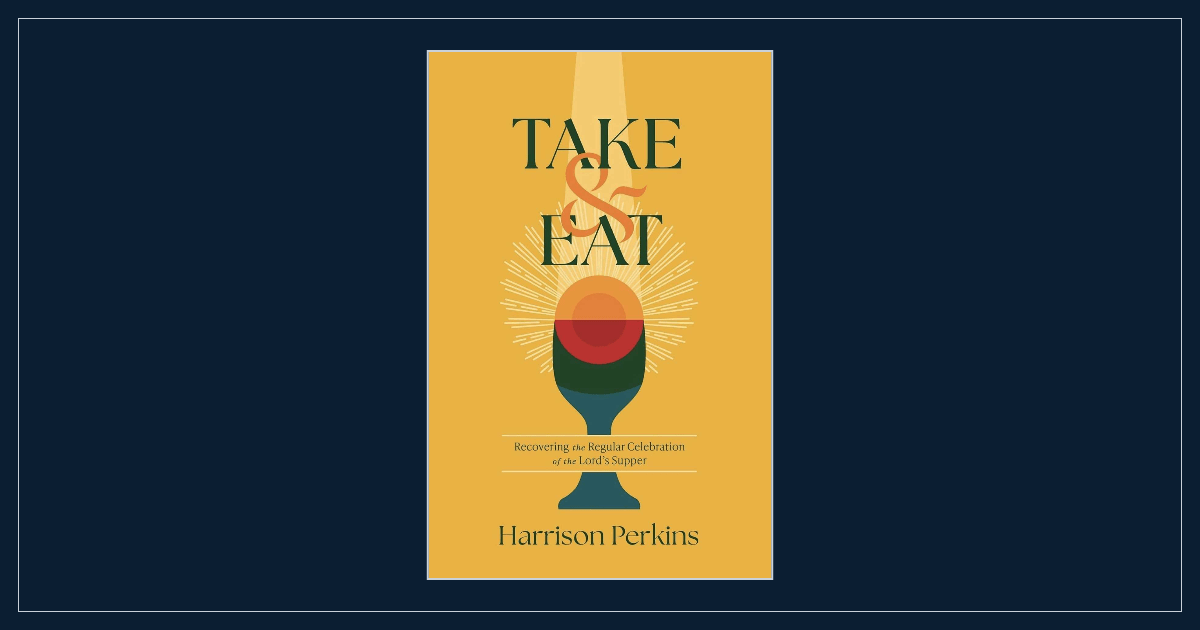
Take and Eat: Recovering the Regular Celebration of the Lord’s Supper
Harrison Perkins • B&H Academic, 2026 • 123 pp.
“The argument is that a proper understanding of the Supper will lead us to recover a frequent and regular celebration of this meal.”1 With that sentence, Harrison Perkins announces both the thesis and his method of Take and Eat. This is not a book that is “narrowly and pedantically on the question of frequency for celebrating the Lord’s Supper.”2
Harrison is after something more foundational: he wants to show us what the Supper actually is, trusting that once we see it clearly, we will not need to be argued into wanting it often.
Harrison (PhD, Queen’s University Belfast) serves as pastor of Oakland Hills Community Church (OPC) in Farmington Hills, Michigan. This book grew out of his own congregation’s transition from monthly to weekly Communion.3
This book is pastoral theology in the best sense because it’s forged in the life of a real congregation. It’s a book grounded in Scripture and the Reformed confessions, and accessible to every Christian who has ever wondered why the Lord’s Supper is celebrated so rarely in their home church.
The Thesis
Harrison frames the problem with a great analogy. Life in this fallen world is like living underwater, and God has provided “special tools that provide to us the oxygen-like resource of saving grace, even as we continue to live in the sin-flooded world that could so easily drown us spiritually.”4
This is the theological engine that drives his book: “the Supper is a way that Christ funnels grace to believers so we might know him and his help more deeply.”5
Harrison Perkins Take and Eat
Harrison doesn’t begin by arguing for weekly Communion and then looking for reasons to support his conclusion. He begins with the nature of the Lord’s Supper and lets frequency follow as the only logical response.
The confessional grounding in this book is outstanding. Drawing on Louis Berkhof, Harrison describes Word and sacrament as:
Objective channels which Christ has instituted in the Church, and to which he ordinarily binds Himself in the communication of His grace.6
Louis Berkhof Systematic Theology, expanded ed
The Supper is not a bare memorial, although some Reformed churches can drift in that direction. It’s a true means of grace, a real channel through which the living Christ delivers himself to his gathered people.
What Is the Celebration of the Lord’s Supper?
Chapter 1 paints a basic portrait of the Lord’s Supper. In addition to the Reformed confessions, I am grateful that Harrison leans heavily on Calvin’s view of the Lord’s Supper. In doing so, he carefully distinguishes the confessional position from both Rome and Zwingli:
Although the bread and wine do not physically turn into Christ’s body and blood, these blessed elements do entail a real, albeit spiritual, reception of Christ’s body and blood and all his benefits.7
Harrison Perkins Take and Eat
Harrison grounds this in Calvin’s own words: “The substance of the sacraments is the Lord Jesus, and the efficacy of them the graces and blessings which we have by his means.”8 The frequency argument comes naturally from this sacramental truth: “a frequent celebration of the Lord’s Supper simply means more occasions for Christ to make us stronger.”9
To illustrate this spiritual-yet-real communion, Harrison employs a contemporary analogy which I loved:
The elements in the Lord’s Supper may not physically become Christ’s body and blood, but they still involve a participation in Christ’s body, blood, and benefits. Like a video call communicates someone’s virtual presence in such a way as to create a real fellowship, the Supper communicates Christ’s presence spiritually so that real fellowship occurs with him in that meal.10
Harrison Perkins Take and Eat
This is a simple image that will be helpful for readers coming from a memorialist background, where the Supper has been reduced to a mental exercise of remembrance rather than a real encounter with the living Christ.
Answering the Objections
Harrison then addresses the objections that keep Reformed congregations from the Table. The first: weekly celebration will make the Supper less special. His answer cuts to the confessional root.
Westminster Shorter Catechism Question 88 defines the means of grace as “The outward and ordinary means whereby Christ communicateth to us the benefits of redemption,” including the sacraments.11 The conclusion is striking: “The sacraments, including the Lord’s Supper, are among God’s ordinary means of grace.”12
By confessional definition, the Supper is not extraordinary. Treating it as rare is not more reverent. It is sub-confessional.
Harrison then makes his most penetrating observation. In Reformed church discipline, the penalty for unrepentant sin is exclusion from the Lord’s Table. Therefore:
When we object to receiving the Supper, we are, in effect, asking to receive the penalty of corrective church discipline. The preference for infrequent Communion is a request to be treated as though we are being rebuked and excluded as if we are unrepentant sinners.13
Harrison Perkins Take and Eat
Harrison closes Chapter 1 by anchoring the argument in Calvin. Reflecting on Acts 2:42, Calvin wrote that “it became the unvarying rule that no meeting of the church should take place without the Word, prayers, partaking of the Supper, and almsgiving.”14
The quarterly practice familiar to many Reformed and Presbyterian churches today was not inherited from Geneva. As Hart and Muether candidly acknowledge, the OPC’s early custom of quarterly Communion was simply maintained from the denomination they left: “we kept the Liberals’ pattern.”15
The Place and Pattern
Chapter 2 grounds the Lord’s Supper in the gathered, corporate worship of the local church. Harrison argues from the Regulative Principle that the Supper is not merely permitted in worship; it is prescribed. Until Christ returns, the church “must proclaim the Lord’s death with rigorous regularity as the central feature of our worship.”16
The chapter’s sharpest point:
Insofar as we endeavor to practice the biblically prescribed elements of worship every time the church gathers, the Lord’s Supper belongs in our worship services as a regular celebration. Jesus himself beckons us to dine with him at that very table.17
Harrison Perkins Take and Eat
If the Supper is a biblically mandated element of worship (as the Westminster Standards and Three Forms of Unity affirm), then a church that routinely omits it on Sunday is liturgically lacking on its own confessional terms.
Chapter 3 makes both a historical and a biblical-theological case for frequent celebration of the Lord’s Supper. The historical evidence is simple. The Didache, written near the end of the first century, commands: “On the Lord’s own day gather together and break bread and give thanks.”18 Weekly Communion is not a liturgical innovation. It’s the recovery of the church’s original practice.
Harrison presses deeper into the biblical theology of God’s presence and holy food, tracing the bread of the presence in the tabernacle, set out every Sabbath as “a permanent covenant obligation.” Calvin saw its significance:
This was no ordinary symbol of God’s favor, when he descended familiarly to them, as if He were their messmate . . . thus He made known His special favor [in this food], as if coming to banquet with them.19
John Calvin quoted in Harrison Perkins, Take and Eat
Harrison also confronts the Zwinglian bare memorial view directly. “The view that the Supper is a bare memorial, which puts focus on our act of remembering and contemplating, empties it of its significance as God’s work to help and nourish his people.”20
The Supper’s power is not in the quality of our contemplation. “The bare memorial view is a symptom of failing to see the Supper as a tangible presentation of the gospel. If our work were primary in the Supper, of course it would be burdensome.”21
The Blessing and the Manner
Chapter 4’s most exegetically compelling moment is Harrison’s treatment of the Emmaus Road. The risen Christ walked with two disciples, opened the Scriptures, and preached the gospel from Moses and the Prophets. Their hearts burned, and still they could not see Jesus. Then he took bread, blessed it, and broke it; and their eyes were opened.
The Supper works together with the Word to bring grace to Christ’s people.22
Harrison Perkins Take and Eat
Upon eating the meal that Christ had blessed, they were able to see him properly. More specifically, they realized what they had already been coming to understand from hearing the Word.23
Harrison Perkins Take and Eat
The sermon prepared the soil of their hearts and the Supper brought the harvest. “The Lord’s Supper brings home and clarifies the preaching of the Word to make us see its truths with greater clarity. It is a scriptural Supper because it helps us feed upon Scripture’s gospel message in a tangible way, opening our eyes to what Scripture is already saying to us.”24
The final chapter holds the book’s two great themes in careful tension.
Harrison does not soften the seriousness of 1 Corinthians 11. “It is clear we risk God’s judgment if we come to the table in an unworthy manner.”25 “Yes, there is risk in coming to the Supper. We must not downplay that risk, recognizing that some people died because of how they received the Supper.”26 And yet: “we must see how the Supper is a motivation and help unto greater holiness and faithfulness in the Christian life. Hence, we should flee from sin because we receive the Supper.”27
The Supper is not a reward for perfect Christians. It produces sanctification in those who come hungry.
The chapter closes with a strong argument that is among the book’s most original. “The frequent celebration of the Lord’s Supper also aids good church discipline.”28 Westminster Confession of Faith 30.4 says that discipline proceeds by “suspension from the sacrament of the Lord’s Supper for a season.”
But if Communion is infrequent, that discipline loses its practical force: “With quarterly or monthly Communion, they could just skip that service without raising eyebrows about their lack of attendance.”29 Weekly Communion makes the fencing of the table visible and meaningful every Lord’s Day.
If there is a shortcoming in the book, it’s that the subtitle promises a recovery of “regular” celebration without defining what “regular” means. The excellent arguments point toward weekly Communion, but Harrison stops short of saying so plainly. Readers looking for a clear confessional case for weekly celebration will find all the ingredients here, but they will have to draw the final conclusion themselves. Since the argument so clearly warrants it, one wishes the book had been titled Take and Eat: Recovering the Weekly Celebration of the Lord’s Supper.
Who Should Read This Book
This book belongs on every elder’s nightstand, especially in churches still celebrating the Supper quarterly. Pastors should read it and hand it to their session or consistory. Laypeople will find it warm, accessible, and worth the afternoon it takes to finish.
The thing about Harrison that I enjoy the most is he has the rare gift of writing with a pastor’s heart and a scholar’s precision.
The book is short, accessible, and theologically serious without being technically demanding. The particular shortcoming Harrison has diagnosed, that “we have often disconnected the question of frequency from the question of what the Supper is and does,” is real, and this book reconnects them convincingly.
A frequent celebration of the Lord’s Supper simply means more occasions for Christ to make us stronger.31
Harrison Perkins Take and Eat
Buy it, read it, and give a copy to your elders.
This wonderful book is scheduled to be released April 15, 2026 and you can purchase it at B&H Academic or at Amazon.
Footnotes
- Perkins, Take and Eat, 3. ↩︎
- Perkins, Take and Eat, 3. ↩︎
- See Perkins, Take and Eat, xiv. ↩︎
- Perkins, Take and Eat, 2. ↩︎
- Perkins, Take and Eat, 5. ↩︎
- Louis Berkhof, Systematic Theology, expanded ed. (Edinburgh: Banner of Truth, 2021), 631; quoted in Take and Eat, 6. ↩︎
- Perkins, Take and Eat, 8. ↩︎
- John Calvin, quoted in Take and Eat, 8. ↩︎
- Perkins, Take and Eat, 13. ↩︎
- Perkins, Take and Eat, 10. ↩︎
- Westminster Shorter Catechism, Q. 88; cited in Perkins, Take and Eat, 14. ↩︎
- Perkins, Take and Eat, 15. ↩︎
- Perkins, Take and Eat, 16. ↩︎
- John Calvin, Institutes of the Christian Religion 4.17.44; quoted in Take and Eat, 21. ↩︎
- D. G. Hart and John R. Muether, quoted in Take and Eat, 21. ↩︎
- Perkins, Take and Eat, 36. ↩︎
- Perkins, Take and Eat, 42. ↩︎
- Didache 14.1; quoted in Take and Eat, 48. ↩︎
- John Calvin, quoted in Take and Eat, 54. ↩︎
- Perkins, Take and Eat, 60. ↩︎
- Perkins, Take and Eat, 61. ↩︎
- Perkins, Take and Eat, 73. ↩︎
- Perkins, Take and Eat, 74. ↩︎
- Perkins, Take and Eat, 75. ↩︎
- Perkins, Take and Eat, 90. ↩︎
- Perkins, Take and Eat, 91. ↩︎
- Perkins, Take and Eat, 92. ↩︎
- Perkins, Take and Eat, 102. ↩︎
- Perkins, Take and Eat, 105. ↩︎
- Perkins, Take and Eat, xiii. ↩︎
- Perkins, Take and Eat, 13. ↩︎