


Have you ever gone to a movie, watched it with your popcorn and candy, and then left utterly dissatisfied with the film? Sure, the treats might have been good. But the movie itself was simply a flop. There is no lasting impact. The movie experience did not meet expectations. The same can be said of any live event: sports, concert, or large party. What might we be expecting at these venues? We are often looking for a life-changing experience.
Another event occurs weekly that should be world-shattering; indeed, it even brings with it implications for the whole cosmos. But through further investigation, is that really taking place throughout the country and the world? The big rub is that we think we know what we want and need when we go to church. Unfortunately, most are being duped. There is only one source that can reveal to us our great need, not only in this life and the next, but with how our lives in both ages are to be ordered. We shall see that worship is the key factor.
Worship or Entertainment?
Matthew Everhard is the senior pastor of Gospel Fellowship Presbyterian Church (PCA). He is a graduate of Malone University (BA, Bible), Ashland Theological Seminary (MA, Practical Theology),  and Reformed Theological Seminary in Orlando (D.MIN). In his new book he has contributed a seminal work towards the ongoing “Worship Wars.”
In Worshiptainment, Everhard immediately states and then defends a Reformed distinctive: the Regulative Principle of worship. Clearly put, he states “[I]f the form, manner, and mechanisms of worship are not commanded in the Bible, we ought not to do them no matter how appealing they may be to the eyes, ears, and senses of men.”[1]
Other Christian traditions posit a supposed freedom with how we may worship God. But Everhard defends the Reformed position: “Our standard of worship is not what we think God might permit – or worse what we think unbelievers might prefer in order to get them to attend – but rather what God does actually require of us in the Scriptures.”[2] In a word, we may only do what God commands in worship.
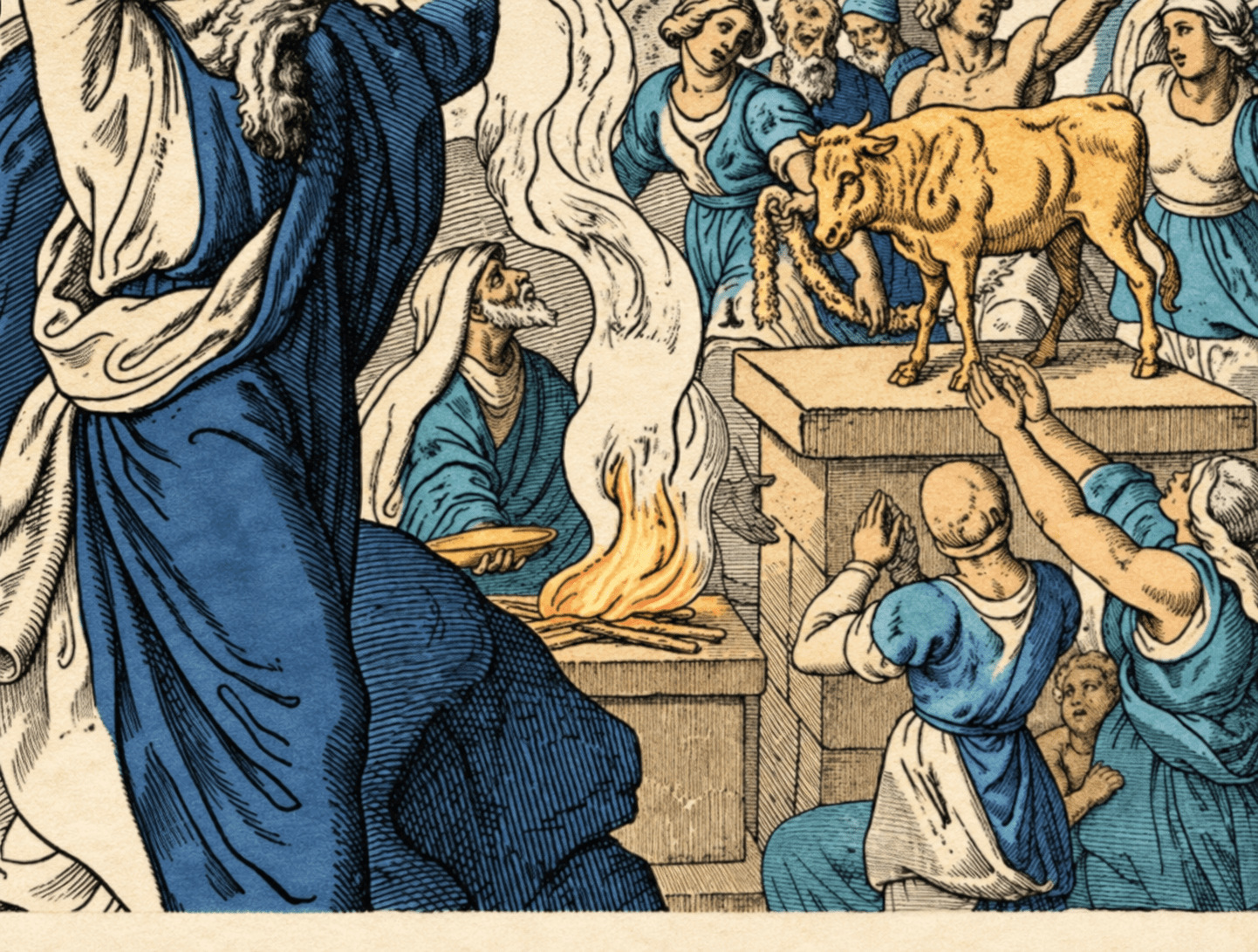
The paradigm of antithesis to the RPW is the golden calf incident of Exodus 32:15-20.[3] Moses is disgusted and breaks the tablets of the law when he sees what Israel has done in making the golden calf, worshiping it as if it had freed them from Egyptian bondage along with sinful worship practices. None are innocent in the melee of idol dance and play.
Everhard contends that much of modern worship is akin to this rebellious incident of Exodus 32. The fog and laser show of today resembles that Israeli quest of old. Moses took too long in returning, so too people today want to feel and see. This idea has merged into pragmatic decisions in how to draw unbelievers into the grand show.
Everhard argues, not only do we do this because we try to attract and be sensitive to the seekers out there, but “we do this because many believers who attend such services are immature and superficial in their understanding of worship.”[4] Quite true. Ignorance is not bliss, but rather, blasphemous.
The Roadmap to Reformed Worship
Everhard seeks to not only defend the Reformed understanding of worship for its own sake, but to defend the Bible’s teaching on the matter.[5] Preaching, Music, Liturgy, and Leadership will be the four points of navigation. But first, human beings may not be inventive in worship. Aaron’s sons Nadab and Abihu discover this truth rather drastically (Lev 10:1-4).[6] God does not compromise on his standards, and he does so towards his creature’s sanctification and for his own glory.[7]
Before the specifics of preaching, music, liturgy, and leadership are discussed in corresponding chapters, Everhard applies the Ten Commandments on right worship and what the Westminster Standards say in reflection upon Biblical truth. He first describes the Reformed position within the RPW of “elements” and “circumstances.”
There is actually great freedom here and a freedom which will honor the true and living God. Sticking close to the RPW means a greater faithfulness, simplicity, and beauty to the Christian life.[8] Adhering to the applications here result in a heartfelt worship in spirit and in truth (Jn 4:23-24).
Preaching
The first way forward is the preaching of the Word of God. In our modern times of a show and the main attraction, the preached word barely makes a cameo. But wherever the word is preached, the power of God unto salvation is present. It is not found in the moving picture and blockbuster illustration. The answer is simply to return to the word. Preach it, at all times, no matter the circumstances (2 Tim 4:2).
Unlike the quick Bible reference in order to only springboard to the analogies that itch ears in worshiptainment, the text of Scripture rules the worship element of the sermon.[9] Everhard argues that expository preaching is the best method to give the church a healthy dose of the whole counsel of God (Acts 20:27). This is the way the church can hear more of God’s revealed Word, for this very Word brings life with it, as only it through the Spirit can.[10]
Singing
Worship in the body of Christ on the Lord’s day ought not be staged as a concert venue. The one who calls us is thrice holy. When it comes to singing in worship, many are giving lip-service and being sung to. This contradicts directly what the people of God should be doing; they should be singing the praises of God. Everhard’s main goal in this chapter is to enliven the word of God to us in song, and the best way to do this is through the original songbook of the people of God: the Psalms.[11] He describes some amount of freedom here, but that ultimately, the Psalms must begin to be used in worship.
Liturgy
When I first began to understand and cling to Reformed distinctives, one of the first cherished ideas was that of liturgy. Historically, the church has had a rich liturgy and theology behind it. Again, there is freedom here. The Reformed tradition has heightened that theology which leads to a fuller and richer liturgy. A return to thoughtful liturgy is more necessary than ever in these current times of worshiptainment.
Without giving too much away, Everhard suggests this need for return in this statement: “A well-ordered liturgy takes the gathered saints through an incredibly beautiful journey in which practically every aspect of the history of redemption is recalled and applied.”[12] Who would not want more of that on their Lord’s Day? When executed correctly as God has ordered, God’s word and the gospel are on full display throughout the entirety of the worship service, not just in the sermon.[13]
Leadership and the Sacraments
All of the previous discussion in the chapters before would be useless unless there were faithful leaders to carry out the task of Biblical worship. What is quite helpful here from Everhard is the warnings about bad leadership. He talks about the qualities and characteristics that you do not want in a faithful and Biblically grounded shepherd.[14] In fact, a faithful and Biblically grounded shepherd would not have those characteristics of the “Dark Octagon.” What the church needs is the ordinary means of grace: the preaching of the word, the administration of the sacraments, and prayer.[15]
It is in the return to these ordinary means, ordained and commanded by God, that will cause the church to thrive. In a modern era of visual enticement and shortened attention spans, the sacraments are all that is needed to satisfy our senses.[16] The call to leaders in the church is to ditch the golden calf of entertainment and return to pure worship.
Cut Out the “tainment”
The call put forth in this book is to truly cherish the Lord, worship him, and give him the glory which is his due. Worshiptainment must be smashed to pieces and discarded wholesale. We must retrieve the central importance of the Lord’s Day and the proper worship of the triune God.[17] For established Reformed churches, this is not a problem (hopefully!). But how this would work out practically in the local worshiptainment church, however, must be done with much prayer and patience. Biblical convictions should bring any reader to the author’s conclusions, but these kinds of changes need not be immediate.[18]
Worshiptainment is to be commended. Matthew Everhard not only provides a right terminal diagnosis of modern evangelical worship, but delivers the cure. The right worship of God is not to be taken lightly. People have died worshiping wrongly![19] Everhard shows us the route forward through the ancient paths. There is much application in these pages, whether you are familiar with Reformed theology or just getting started. Take and read, and worship the Lord rightly, in spirit and in truth. You can purchase this wonderful and timely book here.
Footnotes
- Matthew Everhard, Worshiptainment: The Modern Church’s Golden Calf, (Independent Reformed Media, 2024), 19. See also the definition given on page 34. ↩︎
- Everhard, Worshiptainment, 19. ↩︎
- Everhard, Worshiptainment, 19-21. “Modern worshiptainment leaders would have us believe that God allows us permission to worship Him by almost any means necessary” (20). ↩︎
- Everhard, Worshiptainment, 21. For a concise and God-honoring volume of what worship is and does, see Jonathan Landry Cruse, What Happens When We Worship, (Grand Rapids, MI: Reformation Heritage, 2020). ↩︎
- Everhard, Worshiptainment, 24. ↩︎
- Everhard, Worshiptainment, 31-4. ↩︎
- Everhard, Worshiptainment, 33. ↩︎
- Everhard, Worshiptainment, 45-7. ↩︎
- Everhard, Worshiptainment, 64. ↩︎
- If we take serious the way that the Westminster Larger Catechism 155 describes what the preached Word does, then the church should be ever more ready to have the word read and preached. Everhard, Worshiptainment, 65-6. ↩︎
- Everhard, Worshiptainment, 86-90. ↩︎
- Everhard, Worshiptainment, 118. ↩︎
- Everhard, Worshiptainment, 129-132. ↩︎
- Everhard, Worshiptainment, 166-71. ↩︎
- Everhard, Worshiptainment, 178-83. ↩︎
- Everhard, Worshiptainment, 154. ↩︎
- Everhard, Worshiptainment, 189. ↩︎
- John Calvin in Geneva was very patient in the process of reforming doctrine and worship where he was. For an example, see John Calvin, The Necessity of Reforming the Church, (Sanford, FL: Reformation Trust, 2020). ↩︎
- See the replete Old Testament examples or in the New Testament, Ananias and Sapphira (Acts 5:1-11). ↩︎


You must be logged in to post a comment.