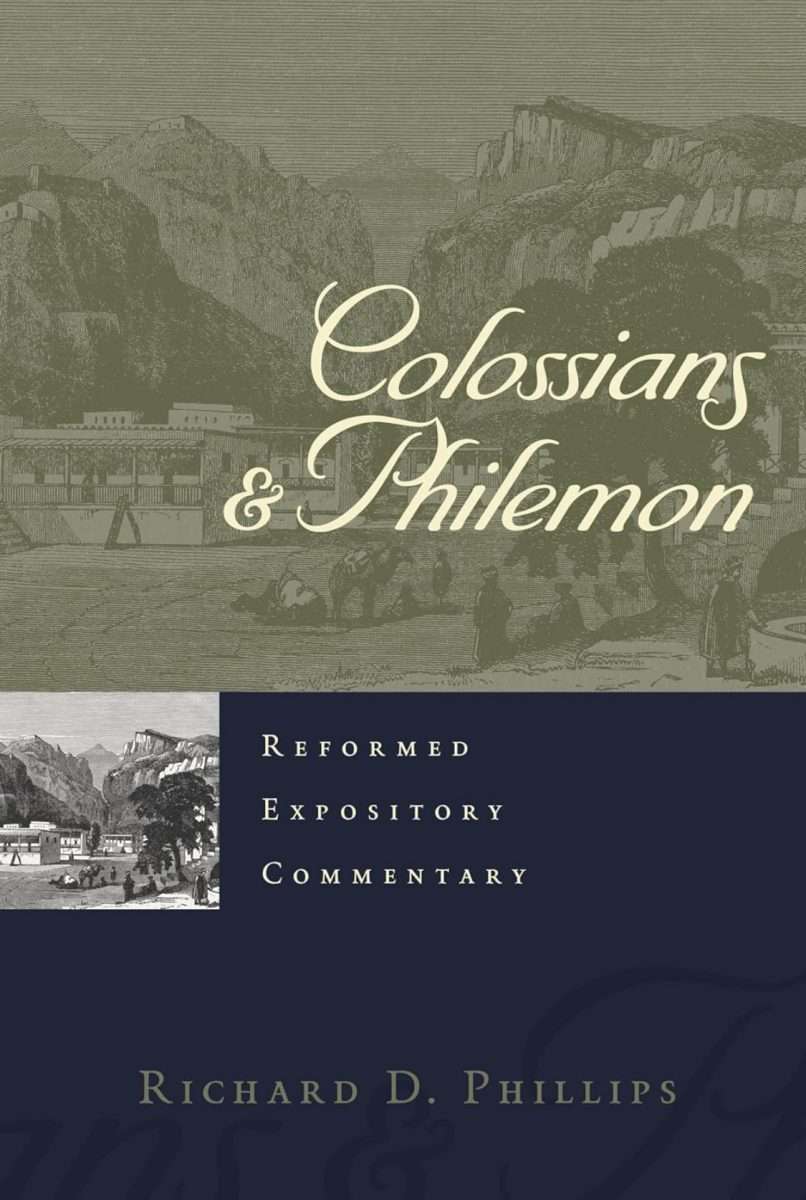
Among the many commentaries on my bookshelf, few have struck the balance between careful exegesis and practical Christian living quite like Richard Phillips’ Colossians and Philemon in the Reformed Expository Commentary series, published by P&R Publishing.
Richard D. Phillips (MDiv, Westminster Theological Seminary; DD, Greenville Presbyterian Theological Seminary) is the senior minister of Second Presbyterian Church in Greenville, South Carolina. He is a prolific author and coeditor of the Reformed Expository Commentary series.
This commentary series is perfect for pastors as well as laypeople, as it is committed to four main things:
- Biblical: Presenting a comprehensive exposition characterized by careful attention to the details of the text.
- Doctrinal: Unashamedly committed to the Reformed theology of the Westminster Standards.
- Redemptive-Historical: Maintaining a Christ-centered view of the Old Testament.
- Practical: Applying the text of Scripture to contemporary challenges Christians face in life.
Having read almost every New Testament volume in this series, I found myself drawn to this one, not just for study, but for its pastoral wisdom and clear application. Phillips writes with clarity and pastoral weight, and his treatment of Christ’s preeminence reframes how I read the letter.
With so much good material to work with, I’ve chosen to highlight seven chapters I keep returning to in my Christian life.
Chapter 2: Bearing Fruit and Growing
Phillips emphasizes that the gospel proves itself in transformed lives. He identifies three key areas of gospel fruit:
- Increasing in the Knowledge of God: “True Christians have a new desire to know and honor God, so that they devote themselves to worship and his Word.”
- Bearing Fruit in Every Good Work: “God’s grace works through believers to witness, teach, serve, and use their gifts and talents in numerous other useful ways.”
- Gracious Character Change (Fruit of the Spirit): “The fruit of the Spirit is love, joy, peace, patience, kindness, goodness, faithfulness, gentleness, self-control.”
Chapter 15: Walk In Him
Phillips reminds us that Paul was a pastor writing to a church of new believers who needed basic instruction in what it meant to be a Christian. This has implications for new Christians today.
In answering the question, “What is a Christian?” Paul affirms the Colossians’ faith:
“Therefore, as you received Christ Jesus the Lord…” (Col. 2:6).
To receive Christ is to believe in His name, and Phillips unpacks the significance of this name:
- “Christ”: His title as the promised Messiah, the One sent to deliver God’s people.
- “Jesus”: Meaning “the LORD saves,” as the angel revealed to Joseph: “…he will save his people from their sins.” (Matt. 1:21)
- “Lord”: The Greek equivalent of Yahweh, identifying Jesus as the eternal God of Abraham, Isaac, and Jacob.
To be a Christian, then, is to believe that Jesus is who the Bible says He is: the Son of God and Savior from sin. Recognizing our need for forgiveness, we trust in His atoning work on the cross.
Chapter 17: The Circumcision of Christ
One of the most theologically fascinating passages in Colossians is Paul’s discussion of the relationship between circumcision and baptism. In 2:11-12, he draws a tight connection between circumcision, baptism, and Christ’s work on the cross. This passage carries significant implications for understanding the continuity between the old and new covenants, and Phillips brings clarity to Paul’s teaching.
Phillips works through Colossians 2:11-12, addressing the “circumcision of Christ” and its connection to baptism. With all the pressure the Colossians were under by the Jewish influence to be circumcised, Paul tells them that those who have believed in Jesus do not need physical circumcision. Why? Because “they have already experienced the spiritual reality to which circumcision points: In him also you were circumcised with a circumcision made without hands, by putting off the body of the flesh, by the circumcision of Christ,” meaning his death on the cross.
When Christians believe in Christ as our Savior by faith, we have union with Christ in his crucifixion. By faith we have received what Moses called in Deuteronomy 10:16 “circumcised hearts.”
Amplifying this connection between circumcision and baptism, Phillips writes that “It is evident that according to Paul, baptism now serves in place of circumcision, so there is a clear relationship between these sacraments. What circumcision symbolized in the old covenant (a sign and seal of God’s covenant), baptism now performs in the new covenant.”
Chapter 19: Nailed to the Cross
Phillips works through the meaning of Christ’s work on the cross with vivid imagery. He draws on Pilgrim’s Progress to illustrate our release from sin’s burden:
“When Christian reached the cross, his burden became loose, fell from his back, and tumbled into the tomb. I never saw the burden again.”
On the legal nature of our guilt, Phillips states: “Paul tells us that Jesus died to cancel the accusation against us in the holy courts of God…’the record of debt that stood against us with its legal demands’ (Col. 2:14).”
Phillips emphasizes Christ’s victory: “Paul continues in Colossians 2:15 to show not only that the record of our debt for sin is canceled and removed, but also that our chief accusers have been silenced by the cross: ‘He disarmed the rulers and authorities and put them to open shame, by triumphing over them in him.’”
Lastly, he underscores the finality of forgiveness: “Because Jesus shed his precious blood for our sins, our forgiveness is final. No record remains of any of our sins, since Jesus nailed our condemnation to his cross.”
God’s grace is as fresh today as it was for the Colossians, and the gospel still gives real assurance: our sins are not merely set aside but completely erased. We have been truly freed to live a life of gratitude to God, no longer relating to Him through works-based, slavish servitude.
Chapter 25: The Reasons of Grace
This chapter explores the basis for grace in the Christian life. Paul writes in Colossians 3:12: “Put on then, as God’s chosen ones, holy and beloved.” Phillips comments on these three key aspects of grace: election, holiness, and love.
- The Reason for Grace
Grace is rooted in God’s sovereign election. Paul teaches that believers are chosen by God, not based on their merit but by His free grace. This echoes Ephesians 1:4, which states that God “chose us in him before the foundation of the world.” The election of believers is an act of God’s love for us before the foundation of the world. It is not based on our righteousness or works. - The Effect of Grace
Since believers are chosen, made holy, and beloved, they are called to live lives reflecting Christ’s character. Phillips writes “Sanctification is by grace, but it is not by grace alone; it also requires moral effort. Thus, the Christian is engaged in projects to cultivate the inward graces of Christ.” Paul urges Christians to “put on” virtues such as compassion, kindness, humility, meekness, and patience (Col. 3:12). Grace not only saves but also empowers believers to grow in Christlikeness.
When we forgive others as we have been forgiven in Christ, when we cultivate gracious virtues in a spirit of true love towards others, then we have truly “put on” Christ before the world.
Chapter 28: Grace in the Workplace
Because of this amazing work of grace that has been taken place in believers, Phillips explains how the gospel transforms our lives, including the workplace. Paul calls on believers to work with sincerity and integrity. For Christians, work is not merely about pleasing earthly employers but about serving Christ Himself. Paul’s exhortation reminds believers that their labor, whether seen or unseen, is ultimately for the Lord. This perspective shapes an attitude of diligence, honesty, and excellence, regardless of circumstances.
A Christian servant [employee] should first be obedient: “Bondservants, obey in everything those who are your earthly masters” (Col. 3:22). The obvious limit is that they cannot be asked to sin, but beyond that, Christian workers are called to be willing subordinates, demonstrating initiative in their tasks and working diligently toward assigned goals. As Phillips notes, “A boss who hires a Christian should be able to expect an honest day’s work for an honest day’s pay.”
Where many workers chase external rewards or self-interest, the gospel calls believers to a higher standard: to work as unto Christ, reflecting His grace in all that we do. As Christians in the workplace, we can be motivated by knowing our work ethic could help to create opportunities for a receptive hearing of the gospel from our co-workers and supervisors.
Chapter 30: Grace Seasoned with Salt
Phillips encourages believers to let their speech be both gracious and discerning. Paul’s metaphor of speech “seasoned with salt” carries a dual meaning:
- Preserving truth in a world prone to decay.
- Making conversations engaging and thought-provoking, drawing others toward Christ.
Phillips critiques the modern saying, “Always preach Christ, and when necessary, use words.” While lifestyle evangelism is crucial, he warns against neglecting verbal proclamation.
Phillips writes “The way for Christians to win converts in a combative society is to conduct our lives in such a way that weary worldly people will seek an explanation for the better way that we live.”
This chapter challenges Christians to be intentional in both actions and words, ensuring that our lives invite curiosity, and our speech leads people to Christ.
Concluding Thoughts
Richard Phillips’ Colossians and Philemon is doctrinally serious and pastorally useful. I came away from it both clearer and more grateful. Phillips opens the text and applies it pastorally. His Christ-centered exposition reminds us that at the heart of Colossians is not just abstract theological argument but the supreme and sufficient Christ: the One in whom our faith is rooted and through whom we live.
It is worth noting that Phillips frequently cites fundamentalist Baptist authors, such as John MacArthur (cited approximately 15 times), and New Perspective on Paul scholar N.T. Wright (cited approximately 11 times) to support his arguments. Given the series commitment to Reformed theology, and the wealth of Reformed scholarship available, this reliance on non-Reformed sources seemed unnecessary.
In my view, Phillips could have effectively made his theological points without relying on these authors. However, his use of their work does not undermine his commitment to Reformed doctrine. Rather, he selectively engages with their contributions where they reinforce his exposition, and his conclusions stay grounded in Reformed convictions.
Final Verdict
This commentary will be an excellent resource for pastors and Bible teachers, providing valuable insights for sermon preparation and theological reflection. Because it is also accessible, it will be very beneficial for lay people with a hunger for depth and theological truth. Colossians and Philemon is a worthy addition to anyone’s library where Christ-centered Reformed exposition is desired. It is consistently practical and theologically engaging. You can purchase this book through Presbyterian & Reformed Publishing!