


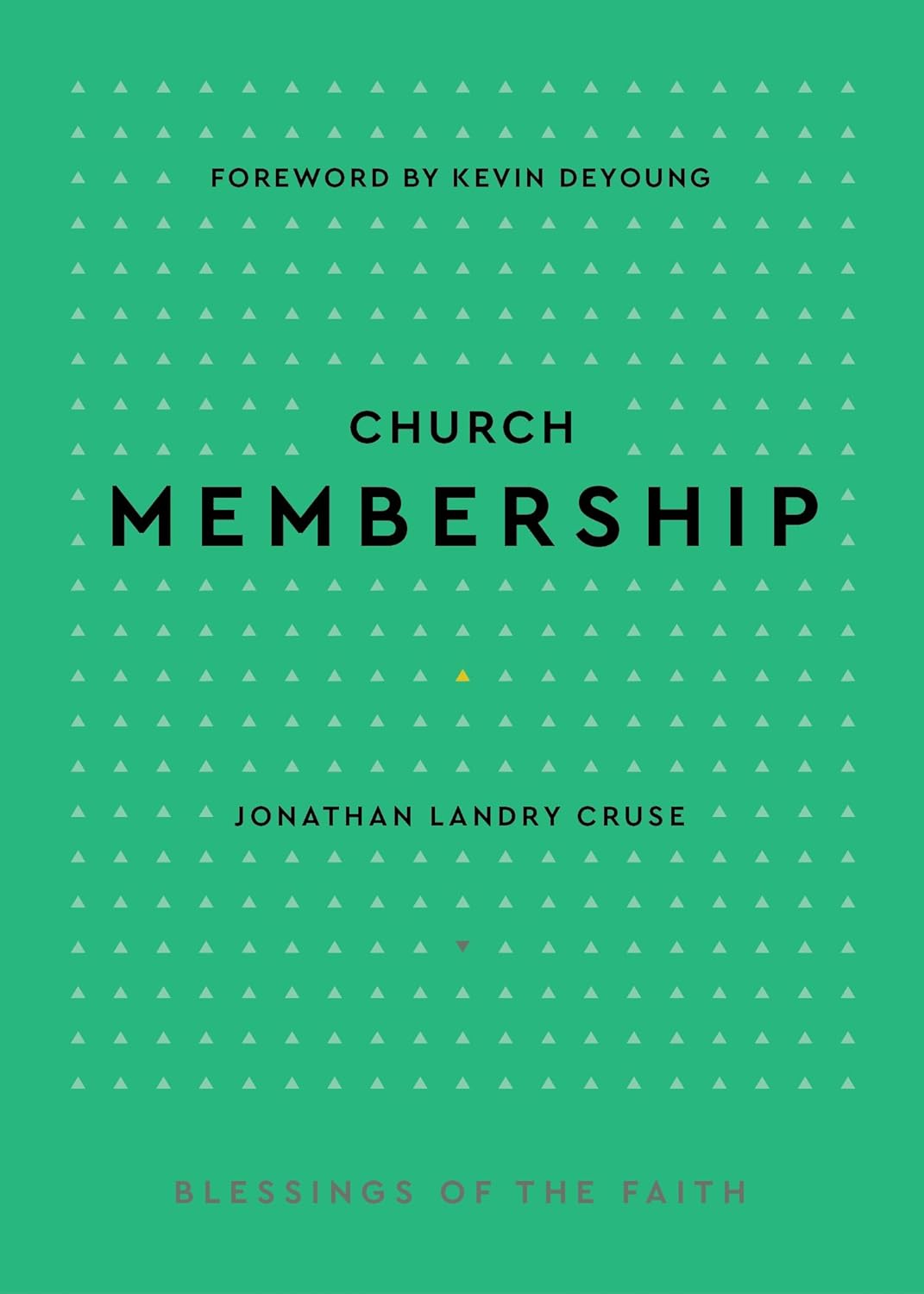
It wasn’t until I began to consider Reformed theology and moving from the church I grew up in to a Reformed church that I actually thought deeply about what it meant to be a member of a church, and until I recently became a member of the church I currently attend, the full realization of what church membership meant had not dawned on me.
While I was in the position of trying to understand the implications of church membership, a book like Church Membership by Jonathan Landry Cruse (MDiv, Westminster Seminary California) would have been immensely helpful, with its simple, yet powerfully effective, explanations of what church membership is and why it is so important.
Cruse, the pastor of Community Presbyterian Church (OPC) in Kalamazoo, MI, carefully deals with four particular facets of church membership, relying on Scripture first, and then the Reformed confessions and other Reformed theologians. 
Every chapter concludes with helpful discussion questions, and the fourth chapter is followed by an extremely applicable question and answer section that touches on many of the most common questions raised by the concept of church membership.
I found that portion particularly helpful as I continue to reflect on my experience transitioning from the church I grew up in to a Reformed church. Cruse also provides a great list of additional resources and helpful endnotes for further research.
The Nature of Church Membership
The first chapter of the book deals with the nature of church membership. Church membership, Cruse writes, “is fundamentally about how we relate to God” and vice versa. Belonging to the church is inextricably tied to belonging to God, for she is the ekklesia (Greek: lit. “called out ones”), called by God out of the world, to fellowship and communion with Him, and for His glory, an incredible privilege (p. 22).
The local church, characterized by the preaching of the word of God, the pure administration of the sacraments, and the exercise of church discipline, is where the Christian “goes to meet with God,” and God’s “greatest means of growing” the believer (p. 31).
In defining the invisible and visible church, Cruse provides an excellent and concise defense of covenant baptism. He also notes that church membership is “the greatest outward expression of our privileged status as God’s possession”(p. 36). “Who wouldn’t want to be a part of that?” Cruse asks, rhetorically, to close the chapter (p. 36). Who wouldn’t, indeed!
The Necessity of Church Membership
In light of the “prevailing practice of many self-identifying Christians today” to reject the idea that a believer must find a local church and have their name recorded on to the membership rolls, Cruse dismantles opposition to church membership by arguing from a historical precedent founded in Scripture, arguing that it is foolish to throw away a practice that has belonged to the church for the past two thousand years (p. 39).
He points to Old Testament records of those belonging to His covenant people Israel, examples of God saying to His people, “‘I know you, and I have a place for you,’” (p. 45) as well as New Testament instances (Acts 4:4) of records being kept (p. 46). “The New Testament,” writes Cruse, “knows nothing of privatized Christianity, rather it presupposes a public faith involving formal membership into the people of God through baptism” (p. 46).
Finally, he argues that since Christ loves the church, those who love Christ ought to love His church–the ultimate reason to join the church is not simply because the Bible commands us to, but because we love Christ.
The Benefits of Church Membership
Having defined the nature of church membership and explained its necessity, Cruse then moves on to listing the myriad benefits of being a member of the church. He lists three in particular as being the “most important”: protection from sin and Satan, the silencing of doubt and instilling of confidence in her members, and the fostering of a community that cannot be compared to anything on earth (p. 53).
I liked how Cruse framed spiritual oversight not as something overbearing and stifling, but as a blessing.
Having grown up in a church lacking consistent care and oversight of the members, I am so thankful for church leaders who have been “appointed…with a mission” to protect members from Satan and his attacks! Even correction and church discipline, uncomfortable as they may be, are a crucial part of this mission (p. 55).
Cruse also highlights the importance of the sacraments (baptism and the Lord’s Supper) being tied to the local church and reserved only for members, such that our faith is nourished and sustained by them, something that can only be found in the church. The church also provides an incomparable community; it is “not a place where Christians happen to be together,” rather, it is a place in which Christians are called to be just that “to and for” each other (pp. 66-67)!
The Responsibilities of Church Membership
This final chapter was an excellent motivation to see the responsibilities of church membership as a joy and privilege, for all that Christ “asks of us in the church, he has already done for us in the gospel” (p. 92). It is in this context, out of gratitude, that we obey the call to prioritize the church, therefore prioritizing “one another over career” and “time reading Scripture over accomplishment” (p. 73).
We make sure that we show up, “not neglecting to meet together” (Heb. 10:24-25), realizing that we meet with “an extraordinary God who speaks to us and meets our needs through his Word” when we go to church (p. 78). We use our gifts to bless others, thinking not of ourselves, but the church (and I loved this particular turn of phrase) “standing down…to our own wants, preferences, and even rights” (p.83).
It is about Christ and his church, not me as an individual, all because of the “gospel blessings that fuel our obedience” (p. 93).
Church Membership was a fantastic book to read, especially on the heels of being publicly received as a member of my church. It reminded me of so many beautiful truths tied into the concept of church membership.
One particularly powerful assertion Cruse makes, beginning in the introduction, is that church membership is the “solution to today’s rampant loneliness problem,” more than that, it is the solution because it is rooted in “God’s gospel answer to sin’s problem from the beginning” (p. 16). Is that not glorious? I was already overjoyed to belong to the church, but reading this book made me that much more excited. It is a brief and easy read, but by no means is the information within easily discarded!
If you are not a member of a church, Jonathan Landry Cruse makes an extremely compelling argument to become one. If you are a member, it will fill you with further joy as you consider the beauty of belonging to God’s people.
It is all about Christ! We belong to the church because we belong to Him, and we love the church because He loves the church. How wonderful it is to be a member of Christ’s church!
You can purchase your copy of Church Membership here!
Note: All quotations other than Scripture taken from Church Membership by Jonathan Landry Cruse (Phillipsburg, NJ: P&R Publishing, 2024).


You must be logged in to post a comment.