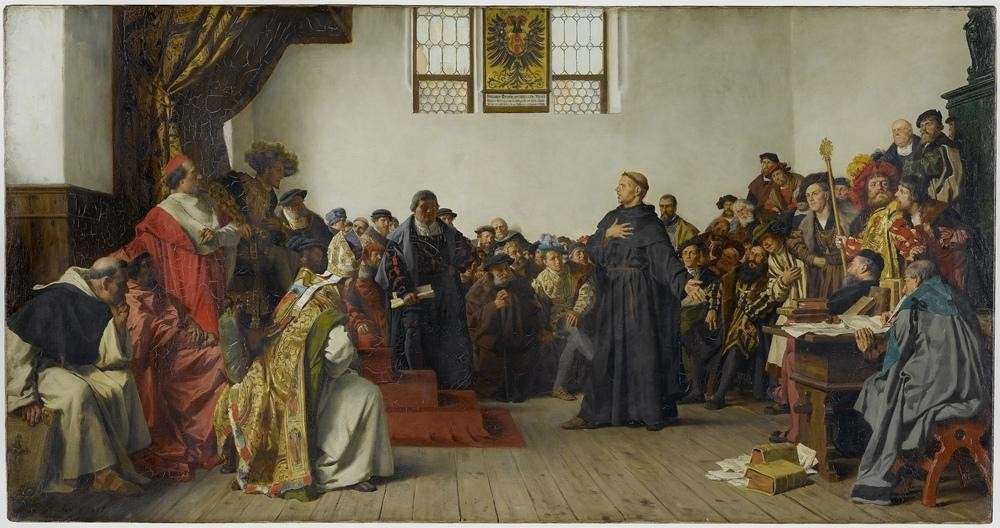
I grew up in a Lutheran church and later came to embrace the Reformed faith. Martin Luther remains a writer I love, and Reformation Week gives me a chance to tell you why. When I read him, I’m reminded how much I need the gospel he worked so hard to recover.
“The true treasure of the Church is the Most Holy Gospel of the glory and the grace of God.”1
Martin LutherThe Ninety-Five Theses, Thesis 62
That sentence gives this post its title. I’ve brought together five resources that I hope will encourage you to spend some time with Luther himself. Each offers something that matters to me as a Christian.
Meet Martin Luther
If you’re wondering where to begin, start with Martin Luther: A Reformed Reader’s Guide. It follows his life and introduces his writings. What I especially want you to meet is Luther the pastor, directing troubled Christians to Christ.
The guide includes this counsel from his Lectures on Galatians:
“We must turn our eyes completely to that bronze serpent, Christ nailed to the cross.”2
Martin LutherLectures on Galatians (1535)
Luther is referring to the bronze serpent Moses lifted up in the wilderness, which Jesus used to point forward to his own crucifixion (John 3:14-15). I love how directly Luther tells us where to look for assurance. When we’re troubled by our sin, we need Christ and his righteousness. A better opinion of ourselves cannot give us peace with God.
The guide also deals honestly with Luther’s failures and the places where Reformed Christians disagree with him. I can love Luther and still have the freedom of a Christian to say where he was wrong.
Read the 95 Theses
Of all the things in The Ninety-Five Theses, the first thesis has always struck me most. Luther says that Christ “willed that the whole life of believers should be repentance.”3
Repentance can so easily become something we place in the past. We can look back on repenting when we became Christians, perhaps twenty years ago, as though that settled the matter. But I still need to repent today. So do all of us who belong to Christ. We still sin, and we still need to confess our sins and turn from them.
That is why this opening thesis means so much to me. Luther brings Christ’s call to repentance into the life I’m living now. The sins we defend or excuse need to be confessed. The forgiveness we seek rests on Christ’s finished work. Our daily repentance does not earn it.
The Theses are an early document, written while Luther was still a Roman Catholic monk. You’ll find assumptions about purgatory that we reject. Read them with that setting in mind, but give the first thesis time to press its question home.
Continue at Heidelberg
Then read The Heidelberg Disputation, from 1518. Its teaching on human inability and the theology of the cross helps explain why Luther points us so firmly away from confidence in ourselves. Thesis 26 puts the distinction between law and grace plainly:
The law says, “do this,” and it is never done. Grace says, “believe in this,” and everything is already done.4
Martin LutherThe Heidelberg Disputation, Thesis 26
I love the comfort in that sentence. God’s law tells me what righteousness requires, and I cannot offer him the perfect obedience he requires. The gospel announces what Christ has accomplished for sinners. I receive his righteousness through faith, as the Belgic Confession, Article 22, confesses.
That gives daily repentance its proper place. We turn from sin as people who have been accepted in Christ. His work is sufficient even while our repentance and obedience remain imperfect. Read a few theses at a time, then continue into Luther’s proofs. There is much here worth slowing down for.
The Freedom of a Christian
I also want to share The Freedom of a Christian, published here as Concerning Christian Liberty. Luther opens this 1520 treatise with two statements that seem to contradict each other:
A Christian man is the most free lord of all, and subject to none; a Christian man is the most dutiful servant of all, and subject to every one.5
Martin LutherConcerning Christian Liberty (1520)
What I love here is the connection between faith and love. Through faith, we receive Christ’s righteousness freely. We don’t have to spend our lives trying to earn a place with God. That frees us to attend to the needs of our neighbors. Our good works become acts of love rather than attempts to secure our own salvation.
That is a reason to obey with gratitude. Christ has already given us what our best works could never earn.
Open the New Testament with Luther
For a shorter read, try Luther’s Preface to the New Testament. One sentence explains why I’m glad to share it:
“The Gospel is not a book of law, but really a preaching of the benefits of Christ.”6
Martin LutherPreface to the New Testament
I love that emphasis on what Christ gives us. We can read the Bible looking only for what we must do and miss the good news of what he has done for us. Luther wants us to hear that good news and receive Christ’s benefits through faith. The obedience that follows grows out of that gift.
Read this preface with discernment, especially where Luther ranks the biblical books and speaks poorly of James. I disagree with him there. The Belgic Confession, Article 4, receives all twenty-seven New Testament books as Scripture. That disagreement does not keep me from appreciating his insistence that we look to Christ.
Why I Hope You’ll Read Him
These are some of the reasons I’m excited to put these resources before you this week. Luther speaks plainly about the sin that remains in us and points us to the Savior we need. I hope you’ll choose a place to begin, read with Scripture open, and find encouragement to repent daily and rest in Christ.
Happy Reformation Week!
Footnotes
- Martin Luther, The Ninety-Five Theses, Thesis 62, trans. C. M. Jacobs, in Works of Martin Luther, vol. 1 (Philadelphia: A. J. Holman, 1915), 29-38. Text. ↩︎
- Martin Luther, Lectures on Galatians (1535), in Luther’s Works, vol. 26, 166-167; excerpt reproduced in Martin Luther: A Reformed Reader’s Guide, “The Biblical Commentaries.” ↩︎
- Martin Luther, The Ninety-Five Theses, Thesis 1, Jacobs translation. Text. ↩︎
- Martin Luther, The Heidelberg Disputation, Thesis 26, in Luther’s Works, vol. 31, 41. This translation is also reproduced in the Presbyterian Historical Society and Presbyterian Foundation’s Selected Readings on the Reformation, 4; the linked RD reading edition uses a different English translation. ↩︎
- Martin Luther, Concerning Christian Liberty (1520), opening propositions, Project Gutenberg eBook 1911; reproduced in the RD reading edition. ↩︎
- Martin Luther, “Preface to the New Testament,” trans. Charles M. Jacobs, in Works of Martin Luther, vol. 6 (Philadelphia: A. J. Holman Company and the Castle Press, 1932), reproduced in the RD reading edition. ↩︎